Key points
- Terpenes are a large group of compounds whose backbone can be traced back to isoprene building blocks. Many occur in the essential oils of plants.
- Not everything with “terpene” in its name is a fragrance compound. The glycyrrhizin of licorice root is a triterpene saponin and tastes about 50 times sweeter than cane sugar.
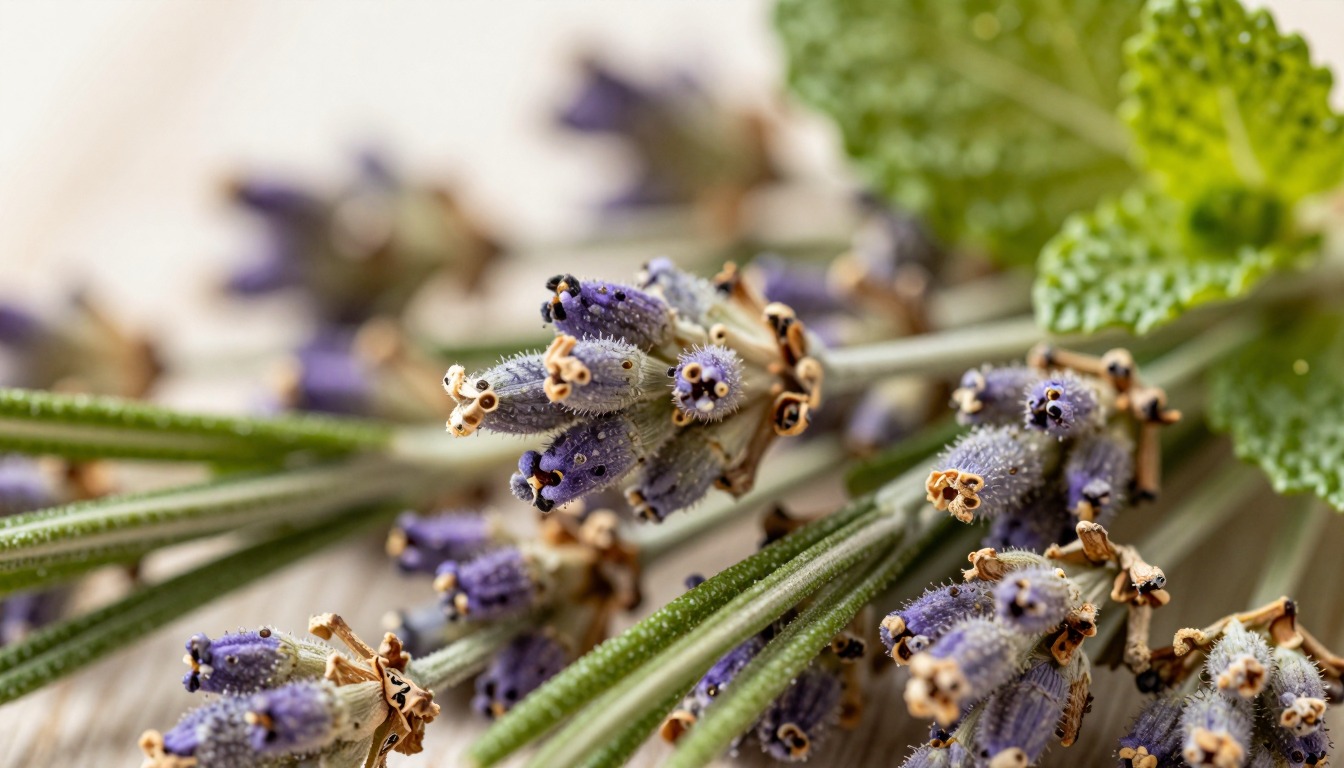
- Eucalyptol, limonene and pinene were detected in individual studies on turmeric leaves and lotus flowers. Which terpenes are in Mild and Mild Silver, we do not know, because there is no measurement for it.
- We make no statement about effects of terpenes when smoked.
Table of contents
- Loading...
Terpenes are not an ingredient but a group of compounds. Chemically, they are built from isoprene units, and many are found in the essential oils of plants. This article explains the chemistry and occurrence, gives boiling points with sources, and says openly what can and cannot be documented about our ingredients. Effects of smoking are not part of it.
What are terpenes?
Short answer: what are terpenes?
Terpenes are a large group of chemical compounds whose basic framework can be traced back to isoprene units of five carbon atoms each. Depending on the number of units, a distinction is made between monoterpenes (C10), sesquiterpenes (C15), diterpenes (C20), triterpenes (C30) and further classes. More than 8,000 terpenes and more than 30,000 terpenoids are known.
| Class | Isoprene units | Carbon atoms | Example from this article |
|---|---|---|---|
| Monoterpenes | 2 | C10 | Limonene, pinene |
| Triterpenes | 6 | C30 | Backbone of glycyrrhizin (itself a triterpene saponin, not a terpene in the strict sense) |
Strictly speaking, terpenes are pure hydrocarbons. When they carry additional functional groups such as alcohol or ether groups, they are called terpenoids. Eucalyptol is such a case.1, 7 Glycyrrhizin goes one step further: it is a saponin and a glycoside, that is, a triterpenoid with a bound sugar component.11 In everyday speech, people often simply say “terpenes” where, strictly speaking, terpenoids are meant.
How an herbal blend is put together overall is explained in Tobacco substitute: what is an herbal smoking blend?. Under tobacco substitute herbal blends you will find the blends Mild and Mild Silver.
Where do terpenes occur?
Essential oils consist largely of terpenes or terpenoids, and many terpenes are also found in plant resins.1 The oils themselves are mixtures of readily volatile substances.2 For the plant, terpenes act as mediators in ecological relationships, for example in defending against herbivores and attracting pollinators. People use them as fragrance and flavor compounds in perfume, cosmetics, food and drinks.3
Terpenes and taste
Short answer: what does taste have to do with volatile substances?
The tongue distinguishes five taste qualities: sweet, sour, salty, bitter and umami. What we experience as taste when eating often comes, for the most part, from volatile aroma compounds that reach the nose through the throat while chewing.4 Descriptions such as “citrusy” or “camphor-like” therefore actually come from the nose.
Four terpenes with boiling points
The four substances from the studies below, with odor and boiling point. Boiling points are given in reference tables for normal pressure (1013.25 hPa); what is meant is the transition from the liquid to the gaseous state.5
| Substance | Classification | Odor | Boiling point | Source |
|---|---|---|---|---|
| 1,8-Cineole (eucalyptol) | Monoterpenoid, bicyclic ether | fresh, camphor-like | 174 to 177 °C | 6, 7 |
| Limonene | monocyclic monoterpene | (R) form pure at most faintly orange-like, (S) form turpentine-like | 175 °C | 8 |
| α-Pinene | bicyclic monoterpene | turpentine-like | 155 °C | 9, 10 |
| β-Pinene | bicyclic monoterpene | turpentine-like | 165 to 166 °C | 9 |
The values apply to the pure substance. They say nothing about dried plant material or smoke, nor about how much of a substance is in a blend.
What can be documented about the seven ingredients
Mild and Mild Silver contain the same seven plant ingredients. We have no measurements of our own on terpenes. What the literature offers varies greatly from ingredient to ingredient, and none of these findings can be transferred to our blends:
| Ingredient | What is documented | Source |
|---|---|---|
| Turmeric leaves | One study on a single variety (Kasur, Pakistan) examined the leaf oil obtained by hydrodistillation. The main component was eucalyptol at 10.27%, along with β-pinene (3.57%), limonene (2.73%) and α-pinene (1.50%). These are proportions in the oil of this variety, not in dried leaves and not in Mild or Mild Silver. | 12 |
| Lotus flower petals | A fragrance analysis of fresh flowers of six Chinese Antique Lotus varieties found 64 volatile components, including 38 terpenoids such as eucalyptol and limonene. In the petals, fatty acid derivatives made up 54 to 77% of the volatile substances, followed by monoterpenes. | 13 |
| Licorice root | Glycyrrhizin, a triterpene saponin of the root, about 50 times sweeter than cane sugar. | 11 |
| Mullein leaves | For common mullein, essential oils are named among the constituents, without individual substances and without stating the plant part. | 14 |
| Blackberry leaves, hollyhock leaves, licorice leaves | No reliable source on individual terpenes found, therefore no statement. | – |
The seven plant ingredients
mullein leaves
blackberry leaves
lotus flower petals
hollyhock leaves
turmeric leaves
licorice root
licorice leaves
The difference between the two varieties lies in composition, mixing ratio and cut, not in a known terpene profile. Mild is softer and more balanced, Mild Silver somewhat more distinctive in character.
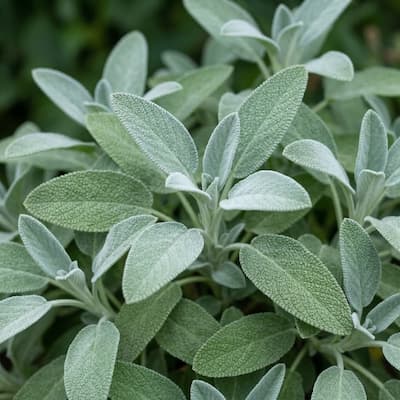
Individual plants have articles of their own, for example Smoking turmeric leaves; an overview is in Which herbs can you smoke?. An example of a herb where constituents matter is Smoking sage.
Why no effects are listed here
Tables circulate online that assign effects to individual terpenes. We have found no study that backs up anything like this for the smoke of an herbal blend. So there are none here.
On top of that: burning produces a mixture of a great many substances. The smoke of an average tobacco cigarette contains up to 12,000 different substances.15 What becomes of a single terpene of the herb in it cannot be read from a boiling point.
Frequently asked questions
More than 8,000 terpenes and more than 30,000 terpenoids are known, most of them as natural products.1
No. Essential oils are mixtures of readily volatile substances that consist largely of various terpenes, sesquiterpenes or aromatic compounds. Terpenes are a part of them, not the whole oil.2
That has not been measured. All that can be documented is the literature on individual ingredients, see the table above.
Both contain the same seven plant ingredients. They differ in composition, mixing ratio and cut. Mild is softer, Mild Silver somewhat more distinctive.
No. A review in ACS Omega (2022) names carbon monoxide, polyaromatic compounds and N-nitrosamines as toxic substances produced when plant material is burned.16 That applies regardless of how natural the material is.
An honest assessment
Tobacco-free does not mean risk-free. Burning plant material produces combustion products such as carbon monoxide and tar, even without tobacco and without nicotine.16, 17 Smoking herbal cigarettes is therefore not “healthy” smoking.
What is left out is the nicotine. We claim nothing more. Mild and Mild Silver are not a health product and not a smoking cessation aid. If you want to quit completely, you can find free advice at rauchfrei-info.de (German-language service), the portal of the German Federal Institute for Public Health.18
Our products are intended for adults.
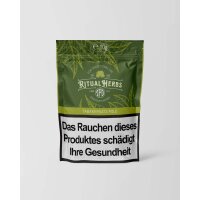
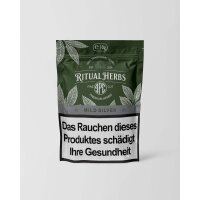
Mild and Mild Silver contain the same seven plant ingredients, mixed and cut differently. Both are available in 10 g and 25 g packs.
Mild and Mild Silver
Read more

Sources
- Wikipedia (in German): Terpene. Retrieved October 2026.
- Wikipedia (in German): Ätherische Öle. Retrieved October 2026.
- Wikipedia: Terpene, sections on ecological roles and uses. Retrieved October 2026.
- Wikipedia (in German): Geschmack (Sinneseindruck). Retrieved October 2026.
- Wikipedia (in German): Siedepunkt. Retrieved October 2026.
- Wikipedia (in German): Eucalyptol. Retrieved October 2026.
- Wikipedia: Eucalyptol. Retrieved October 2026.
- Wikipedia (in German): Limonen. Retrieved October 2026.
- Wikipedia (in German): Pinene. Retrieved October 2026.
- Wikipedia: Pinene. Retrieved October 2026.
- Wikipedia (in German): Glycyrrhizinsäure. Retrieved October 2026.
- Parveen Z, Nawaz S, Siddique S, Shahzad K: Composition and Antimicrobial Activity of the Essential Oil from Leaves of Curcuma longa L. Kasur Variety. Indian Journal of Pharmaceutical Sciences 2013. PMC3719142.
- Wei H et al.: Untargeted metabolites profiling of volatile components of Chinese Antique Lotus (Nelumbo nucifera Gaertn.) using solid-phase microextraction (SPME) GC/MS. PeerJ 2025. PMC12182725.
- Wikipedia (in German): Kleinblütige Königskerze. Retrieved October 2026.
- Wikipedia (in German): Zigarette, section on constituents of tobacco smoke. Retrieved October 2026.
- Abdel Rahman RT, Kamal N, Mediani A, Farag MA: How Do Herbal Cigarettes Compare To Tobacco? ACS Omega 2022. doi:10.1021/acsomega.2c04708.
- Wikipedia (in German): Kräuterzigarette. Retrieved October 2026.
- German Federal Institute for Public Health: rauchfrei-info.de (in German). Retrieved October 2026.

x
Please sign in to write a comment.