Key points
- Blackberry leaves are one of seven ingredients in Ritual Herbs Mild and Mild Silver. Raspberry leaves are not in them.
- Blackberries are not a single species but a section of the genus Rubus with several thousand species.
- The leaves contain tannins and flavonoids. They are used as a tea and, fermented, also as a substitute for black tea.
- Blackberry and raspberry leaves come from related plants but differ in fruit, growth habit and thorns.
- Even nicotine-free herbal smoke is smoke. Burning produces carbon monoxide and other combustion products.
Table of contents
- Loading...
Blackberry leaves are part of our fine cut: Ritual Herbs Mild and Mild Silver contain them, alongside six other plant ingredients. Raspberry leaves, on the other hand, are not in our blends. That is why we keep the two plants cleanly apart here.
This article covers the botany, constituents and use of the leaves. We promise no effect when smoked.
What are blackberry leaves?
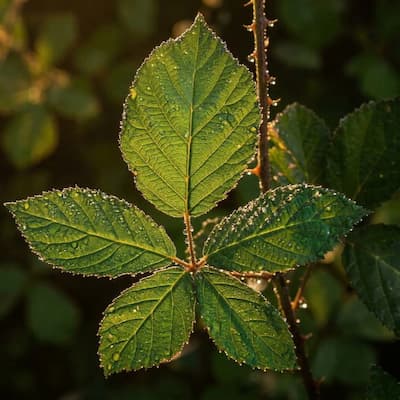
Blackberry leaves are the pinnate, toothed leaves of blackberry shrubs, a section of the genus Rubus in the rose family (Rosaceae). It is not a single species: the true blackberries (Rubus sect. Rubus) are grouped together as the aggregate species Rubus fruticosus agg. The section comprises several thousand species; in Europe alone, more than 2,000 have been described. They are widespread in the temperate regions of the Northern Hemisphere: Europe, North Africa, Western Asia and North America.
The canes are biennial, the shrubs grow 0.5 to 3 metres tall and climb by sprawling. The thin, tough thorns serve as a climbing aid and as protection against browsing. The name itself is old: the German word Brombeere developed from the Old High German brāmberi, which means roughly “thorn-bush berry”.
- Botanical: Rubus sect. Rubus (aggregate species Rubus fruticosus agg.), rose family (Rosaceae)
- Growth habit: shrubs with biennial canes, 0.5 to 3 m tall, sprawling climbers
- Leaves: odd-pinnate with three, five or seven leaflets, leaflets toothed
- Flowering season: May to August; the blue-black fruits ripen from mid-July to September
- Habitat: sunny to semi-shaded spots, for example light woodland and its edges, on soils rich in lime and nitrogen
- Picking time for tea leaves: best in the first half of May
What is in the leaves?
Blackberry leaves contain tannins (gallotannins and dimeric ellagitannins), flavonoids, fruit acids such as citric acid and isocitric acid, and some vitamin C. Tannins have an astringent (puckering) effect and are known as a flavour component of tea and wine.
That fits how we describe the leaves: mild-tart and slightly astringent, a calm, green plant base. That is a statement about taste, not about effect. We make no claim about what the constituents do when smoked. We give no content figures in percent because we have not found a reliable source for them.
What is handed down about their use?
Blackberry leaves are mainly used as a tea. Fermented, they serve as a substitute for black tea and are sold as a caffeine-free breakfast tea.
We have not found a handed-down history of blackberry leaves as a smoking herb substantiated. That is why we do not tell one.
Blackberry leaves in Mild and Mild Silver
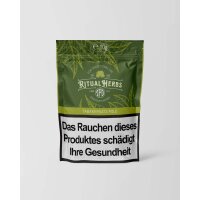
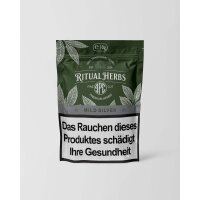
Ritual Herbs Mild and Mild Silver contain the same seven plant ingredients: mullein leaves, blackberry leaves, lotus flower petals, hollyhock leaves, turmeric leaves, licorice root and licorice leaves. Both varieties are tobacco-free and nicotine-free. The difference lies in composition, blending ratio and cut.
The seven plant ingredients
In Mild and Mild Silver
mullein leaves
blackberry leaves
lotus flower petals
hollyhock leaves
turmeric leaves
licorice root
licorice leaves
In herbal blends, blackberry leaves add volume, structure and a gentle, plant-based base note. We do not reveal their share. Behind blend and cut stand several years of development work, and the ratio remains our recipe. Mild is soft and restrained in flavour, Mild Silver somewhat more distinctive. Both are finely cut and tuned for a calm, as even as possible burning behaviour.
We source the herbs primarily from Europe, supplemented by selected, wild-picked herbs from India. Final processing takes place in Germany. We do not specify here which herb comes from where. Both varieties are available as 10 g and 25 g packs on the Tobacco substitute page. How to store the blend is explained in the article Smoking mullein.
How the blends are put together overall is covered in Tobacco substitute: what is an herbal smoking blend?; more plants are listed in Which herbs can you smoke?.
How do blackberry and raspberry leaves differ?
Blackberry and raspberry both belong to the genus Rubus but are different plants. The raspberry (Rubus idaeus) is a single species. Its red or orange fruits sit only loosely on the receptacle, and the underside of its pinnate leaves is strikingly densely white-felted. Blackberries have blue-black fruits that are firmly attached to the receptacle. Only blackberry leaves are an ingredient of Ritual Herbs Mild and Mild Silver.
| Blackberry | Raspberry (Rubus idaeus) | |
|---|---|---|
| Botanical | section of the genus Rubus, several thousand species | single species of the genus Rubus |
| Growth | 0.5 to 3 m, sprawling climber | mostly 1 to 1.5 m (0.5 to 3 m) |
| Thorns | thin and tough | fine, short, delicate, up to 2 mm |
| Fruit | blue-black, firmly attached to the receptacle | red or orange, only loosely attached to the receptacle |
| Leaf underside | not described in our sources | strikingly densely white-felted |
| Flowering season | May to August | May to June, to July or August |
| Tannins in the leaves | gallotannins, dimeric ellagitannins | gallotannins, ellagitannins |
| Use of the leaves | tea, fermented as a substitute for black tea | tea |
| In Mild and Mild Silver | yes | no |
Frequently asked questions
Yes. Blackberry leaves are one of seven ingredients in Mild and Mild Silver, alongside mullein leaves, lotus flower petals, hollyhock leaves, turmeric leaves, licorice root and licorice leaves.
No. Raspberry leaves are not among the seven ingredients of Mild and Mild Silver.
We describe them as mild-tart and slightly astringent, with a gentle, plant-based base note.
Mild and Mild Silver are tobacco-free and nicotine-free. The blackberry is a member of the rose family; tobacco belongs to the nightshade family, so to a different plant family.
We make no such claim. A tobacco substitute is not a health product. Burning plant material produces smoke containing carbon monoxide and other combustion products, even without tobacco and nicotine.
Primarily from Europe. In addition we source selected, wild-picked herbs from India that grew without fertiliser and without chemical treatment. Final processing takes place in Germany.
An honest assessment
Tobacco-free does not mean risk-free. Burning plant material produces smoke, and that smoke contains combustion products such as carbon monoxide and tar. Carbon monoxide forms during the incomplete combustion of carbon-containing substances, whether tobacco or herbs are burning.
A Korean study from 2015 compared the smoke constituents of a nicotine-free, mugwort-based herbal cigarette with a tobacco cigarette. The herbal cigarette came to 12.30 mg of carbon monoxide and 7.45 mg of tar per cigarette, the tobacco cigarette to 6.07 mg of carbon monoxide and 6.02 mg of tar. In the test, the smoke condensate showed a higher mutagenic potential than that of the tobacco cigarette at the same concentration. This applies to this one tested product and not automatically to our blends. But it shows that nicotine-free is not the same as harmless.
What falls away with our blends is the tobacco and the nicotine. We claim nothing more. Ritual Herbs is aimed at adults. If you want to quit entirely, talk to a doctor or a counselling service about it.
Blackberry leaves in the finished blend
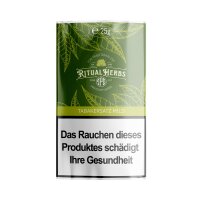
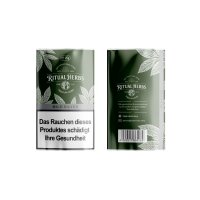
Mild and Mild Silver contain the same seven plant ingredients, blended and cut differently. Both come in 10 g and 25 g packs.
Another leaf is covered in Smoking bilberry leaves.
Mild and Mild Silver
Keep reading
Sources
- Brombeeren, Wikipedia (in German): section and family, number of species, distribution, growth habit, leaves, thorns, habitats, flowering season, fruits, tannins and constituents of the leaves, use as tea and tea substitute, origin of the name.
- Rubus fruticosus, Wikipedia (in German): aggregate species Rubus fruticosus agg., leaf shape and constituents, picking time for tea leaves.
- Himbeere, Wikipedia (in German): species Rubus idaeus, family, growth, thorns, fruit, leaf underside, flowering season, tannins of the leaves, use as tea.
- Gerbstoffe, Wikipedia (in German): astringent effect, tannins as a flavour component of tea and wine.
- Virginischer Tabak, Wikipedia (in German): nightshade family.
- Bak JH, Lee SM, Lim HB: Safety Assessment of Mainstream Smoke of Herbal Cigarette, Toxicological Research, 2015: carbon monoxide, tar and mutagenicity of the smoke of a mugwort herbal cigarette compared with a tobacco cigarette.
- Kohlenstoffmonoxid, Wikipedia (in German): formation during incomplete combustion.
x
Please sign in to write a comment.