
Key points
- Under section 1(8) of the German Tobacco Tax Act (Tabaksteuergesetz, TabStG), products that consist wholly or partly of substances other than tobacco are treated as cigarettes or smoking tobacco if they meet the other requirements. An herbal blend for smoking can therefore also be subject to tobacco tax.
- Tobacco tax is paid by means of tax stamps (Steuerzeichen) affixed to the retail pack. They must have been used before the tax arises.
- All Ritual Herbs products carry a German tax stamp.
- This is not tax advice. We do not state tax rates; the legal text is what counts and, in individual cases, the customs authority.
Table of contents
- Loading...
Tobacco tax on herbal blends? Yes, that can happen, even though there is no tobacco in them. The Tobacco Tax Act does not look at tobacco alone but at the nature of the product: it has to be suitable for smoking. Here is what the legal text and the customs authority say, how the tax stamp works and how you can recognise it. What counts as a tobacco product under the Tobacco Products Act is covered in a separate article: German Tobacco Products Act and herbal blends.
When do herbal blends fall under tobacco tax?
In short: is an herbal blend subject to tobacco tax?
Under section 1(8) of the Tobacco Tax Act, products that consist wholly or partly of substances other than tobacco are treated as cigarettes or smoking tobacco, provided they meet the other requirements. The customs authority gives the herbal cigarette as an example. A product that is not meant for smoking at all is not covered.1, 4
The Act names tobacco products and certain other products as the object of the tax. The definition of tobacco products is in section 1(2), the equal treatment in subsection 8. The wording (German original; the English below is our translation):1
„Als Zigaretten oder Rauchtabak gelten Erzeugnisse, die statt aus Tabak ganz oder teilweise aus anderen Stoffen bestehen und die sonstigen Voraussetzungen nach Absatz 2 Nummer 2 oder Nummer 3 erfüllen.“
Our translation: “Products that consist wholly or partly of substances other than tobacco instead of tobacco, and that meet the other requirements under subsection 2 number 2 or number 3, are treated as cigarettes or smoking tobacco.”
The tax arises under section 15 TabStG when the goods are released for consumption, unless a tax exemption follows.3 The section on the tax stamp shows what that looks like in practice.
What does “treated as” mean?
Subsection 8 refers to subsection 2 number 2 (cigarettes) and number 3 (smoking tobacco). The Act defines smoking tobacco like this (German original; our translation below):1
„Rauchtabak (Feinschnitt und Pfeifentabak): geschnittener oder anders zerkleinerter oder gesponnener oder in Platten gepresster Tabak, der sich ohne weitere industrielle Bearbeitung zum Rauchen eignet.“
Our translation: “Smoking tobacco (fine-cut and pipe tobacco): tobacco that is cut or otherwise shredded or spun or pressed into slabs and that is suitable for smoking without further industrial processing.”
In an herbal blend, the plant takes the place of the tobacco. What matters are the remaining features: cut or shredded, and suitable for smoking without further industrial processing. The customs authority describes herbal smoking products as products made from “other plants, herbs or fruits” that are consumed by burning without tobacco, and counts them among the goods subject to tobacco tax.5
| Product | Classification under section 1 TabStG | Source |
|---|---|---|
| Cigarette, fine-cut or pipe tobacco made from tobacco | Tobacco product (subsection 2 nos. 2 and 3) | Source 1 |
| Smoking product made wholly or partly from substances other than tobacco that meets the requirements of no. 2 or 3 | treated as a cigarette or smoking tobacco (subsection 8) | Source 1 |
| Herbal cigarette | according to customs, a product treated like a cigarette | Source 4 |
| Product made wholly from other substances that serves exclusively medical purposes and is a medicinal product within the meaning of the German Medicines Act | excluded (subsection 8) | Sources 1, 4 |
| Products for devices that produce aerosol or vapour, unless subsection 8 or 2b applies | substitute for tobacco products (subsection 2c), a topic of its own | Source 1 |
How customs classifies a particular product in an individual case is something we cannot judge from the outside. Besides the herbal cigarette, the customs page on tobacco products names further examples, such as the tea stick as a product treated like heated tobacco. Our table is no substitute for a binding ruling.
What is a tax stamp and how is tax paid with it?
In short: what is a tax stamp?
A tax stamp (Steuerzeichen) is the label or strip with which tobacco tax on tobacco products is paid. Under section 17(1) TabStG, cancelling it and affixing it to the retail pack count as using it; both must have happened by the time the tax arises.2, 6
In everyday German you hear Steuermarke or Banderole. The customs authority describes tax stamps as labels or strips on security paper, in principle produced by the Bundesdruckerei (the federal printing office). The reason: they make tax supervision and tax collection easier.6 Manufacturers and importers of tobacco products are entitled to obtain them. If they hold a tax warehouse licence, they may use the stamps only in the tax warehouse for which they were obtained. Passing them on to third parties is in principle not permitted.6
The same page says that the stamp must match the pack: it has to fit the quantity and the retail price of the pack.6
How does the tax stamp get onto the pack?
The process as the Act and customs describe it, in the order in which it takes place:
Schritt 1
Order and declare.
Manufacturers or importers order the tax stamps with form 1619 (“Steueranmeldung für Steuerzeichen”, tax return for tax stamps) from the Main Customs Office Bielefeld (Hauptzollamt Bielefeld) and calculate the tax stamp debt themselves. (Sources 2, 6, 8)
Schritt 2
Cancel.
A light-fast and water-resistant cancellation mark is printed on the stamp, containing parts of the purchaser number. This makes it possible to trace who obtained the stamp. (Source 6)
Schritt 3
Affix.
The stamp sits on the retail pack in such a way that the goods cannot be removed without damaging the stamp or the pack. (Source 6)
Schritt 4
Sell.
Customs describes that tobacco products are released for consumption only in closed, ready-for-sale retail packs. Retailers keep the packs closed and the tax stamps intact. (Source 7)
The customs page also names ordering deadlines: as a rule one week before the stamps are needed, and at least four weeks for larger quantities or new varieties.6 That concerns manufacturers, not you as a customer. It does show, though, that behind the small stamp there is a procedure with deadlines and records.
Tax stamps at Ritual Herbs
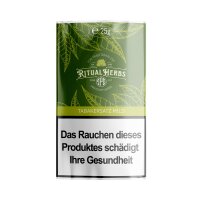
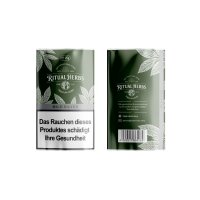
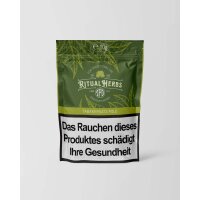
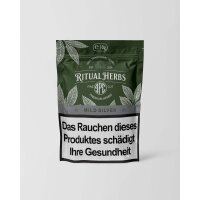
All Ritual Herbs products carry a German tax stamp. That includes Mild and Mild Silver, both made from the same seven plant ingredients: mullein leaves, blackberry leaves, lotus flower leaves, hollyhock leaves, turmeric leaves, liquorice root and liquorice leaves. They are tobacco-free and nicotine-free; they are still a smoking product. Under section 1(8) TabStG, what counts is whether the product meets the requirements for cigarettes or smoking tobacco, not the list of ingredients alone.1 You will find the range under Tobacco substitute, and the background in Tobacco substitute: what is an herbal smoking blend?.
The easiest way to check for yourself: the stamp sits intact on the pack. According to the customs description, it must not be possible to detach it without visibly damaging the stamp or the pack.6, 7 A pack without a tax stamp, or with a damaged one, should not be regarded as regularly taxed goods. Customs names exceptions to the use of tax stamps for, among others, goods that are imported privately and are not intended for trade or commercial use.6
What the tax does not tell you
A tax stamp shows that tobacco tax has been paid. It says nothing about ingredients, quality or safety. The minimum age of 18 and the labelling on the pack are separate topics: Age limit for herbal smoking products and Warning labels on herbal products.
And smoke stays smoke. A review article in ACS Omega (2022) lists carbon monoxide, polyaromatic compounds and N-nitrosamines, among others, as substances of concern in herbal cigarettes.9 A Korean study (2015) found more carbon monoxide and benzo[a]pyrene in the smoke of an herbal cigarette than in that of a tobacco cigarette.10
Mild and Mild Silver: the blends in the shop
Frequently asked questions
Herbal blends for smoking can be. Under section 1(8) TabStG, products that consist wholly or partly of substances other than tobacco are treated as cigarettes or smoking tobacco if they meet the other requirements. Excluded are products made wholly from other substances that serve exclusively medical purposes and are medicinal products within the meaning of the German Medicines Act.1
For products that fall under section 1(8) TabStG, the tax is paid by means of the tax stamp. Nicotine-free or tobacco-free does not change that; what matters is whether the product meets the requirements for cigarettes or smoking tobacco. All Ritual Herbs products carry a German tax stamp.1
Under section 17(2) TabStG, manufacturers or importers calculate the tax stamp debt themselves and declare it. It arises when the stamps are obtained, and the debtor is the purchaser, that is, the person or company that orders and receives the tax stamps. As a customer, you do not order tax stamps.2, 8
We do not give a figure. The amount depends on the tax rate, and we have not checked that for this article. The legal text and the information from the customs authority are what counts.
No. The article reproduces what the legal text and the customs pages say. For the tax classification of a specific product, the customs authority is responsible; for individual questions, a tax adviser can help. We report what is written there and mark what we have not checked.
An honest assessment
What we do not know: whether and how customs would classify a particular other product. We have not included tax rates or current deadlines; the customs pages carry no date, and changes are possible. This text is not tax advice.
Tobacco-free does not mean risk-free. Smoke from plant material contains combustion products. Mild and Mild Silver are not a health product and not a means of quitting smoking. If you want to stop, you will find free counselling at rauchfrei-info.de, the information portal of the Federal Institute for Public Health (in German), and by phone on 0800 8 31 31 31 (Germany).11 Ritual Herbs is aimed at adults.
Read more


Sources
- Tabaksteuergesetz (TabStG, German Tobacco Tax Act), § 1 object of the tax, smoking tobacco (subsection 2 no. 3), equal treatment (subsection 8): gesetze-im-internet.de/tabstg_2009/__1.html. Retrieved on 24 October 2026.
- Tabaksteuergesetz (TabStG), § 17 tax stamps: gesetze-im-internet.de/tabstg_2009/__17.html. Retrieved on 24 October 2026.
- Tabaksteuergesetz (TabStG), § 15 arising of the tax, tax debtor: gesetze-im-internet.de/tabstg_2009/__15.html. Retrieved on 24 October 2026.
- Zoll online (German customs, in German): Tabak, Steuergegenstand im Tabaksteuerrecht (“Tabakwaren gleichgestellte Erzeugnisse”) (tobacco, object of tax under tobacco tax law; products treated like tobacco products). Retrieved on 24 October 2026.
- Zoll online (in German): Tabakerzeugnisse und verwandte Erzeugnisse (tobacco products and related products, including herbal smoking products). Retrieved on 24 October 2026.
- Zoll online (in German): Verwendung von Steuerzeichen (use of tax stamps). Retrieved on 24 October 2026.
- Zoll online (in German): Handel mit Tabakwaren und Substituten für Tabakwaren (trade in tobacco products and substitutes for tobacco products). Retrieved on 24 October 2026.
- Zoll online (in German): Steueranmeldung bzw. Steuererklärung (tax return and tax declaration). Retrieved on 24 October 2026.
- Abdel Rahman RT, Kamal N, Mediani A, Farag MA: How Do Herbal Cigarettes Compare To Tobacco? ACS Omega 7(50), 2022. PMC9773184.
- Bak JH, Lee SM, Lim HB: Safety assessment of mainstream smoke of herbal cigarette. Toxicological Research 31(1), 2015. doi:10.5487/tr.2015.31.1.041 (abstract via Europe PMC).
- Bundesinstitut für Öffentliche Gesundheit (Federal Institute for Public Health): rauchfrei-info.de (in German). Retrieved on 24 October 2026.



x
Please sign in to write a comment.