The key points in brief
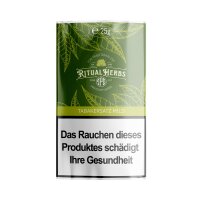
- Herbal smoking products need a text warning on the pack and on any outer packaging. The mandatory wording is German and is printed as it stands: „Das Rauchen dieses Produkts schädigt Ihre Gesundheit.“ It says that smoking this product damages your health (§ 30 TabakerzV, Art. 21 Directive 2014/40/EU).6, 8
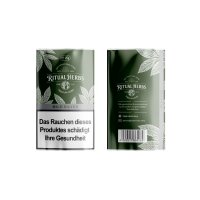
- It sits on the outer front and back and covers 30 percent of that surface each time, in bold Helvetica (the law spells it “Helvetika”), black on white, centred.6, 7
- The law names combined text-and-picture warnings for cigarettes, roll-your-own tobacco and waterpipe tobacco. The section on herbal smoking products (§§ 29, 30) contains no such rule.5, 3
- Not allowed on the pack: claims that the product is free of additives or flavourings, as well as hints at lower harm and at health effects.2, 8
- Sources accessed on 24 October 2026. This is a reproduction of statutes, not legal advice.
Table of contents
- Loading...
The warning on cigarettes comes with pictures; the one on herbal blends is a single sentence. That sentence is mandatory all the same, and it is laid down precisely: wording, area, typeface. On top of that come two lists of banned claims for packaging. The rules described here are German and EU law. We explain the basics of the act in the article German Tobacco Products Act explained.
Which warning is required on herbal blends?
In short: which warning appears on herbal smoking products?
The required sentence is the German „Das Rauchen dieses Produkts schädigt Ihre Gesundheit.“ In plain terms: smoking this product damages your health. It must appear on every pack and every outer packaging, on the outer front and back, and cover 30 percent of that surface each time. The legal bases are § 17 para. 1 TabakerzG, § 30 TabakerzV and Article 21 of Directive 2014/40/EU.1, 6, 8
§ 17 para. 1 TabakerzG says that herbal smoking products may only be placed on the market if their packs and outer packaging carry the following:
„mit gesundheitsbezogenen Warnhinweisen versehen sind“
Our translation: “are provided with health warnings”
Para. 2 authorises the competent ministry to regulate the content and form of the labelling by ordinance.1 That is what § 30 TabakerzV does. The section of the ordinance on herbal smoking products has only two sections in total: § 29 (notification duties) and § 30 (warning).5, 6
The EU Directive sets the same wording. Article 21 para. 1 requires it on:
„jede Packung und jede Außenverpackung“
Our translation: “every pack and every outer packaging”
The Directive’s own English-language version reads “Smoking this product damages your health.”8 The sentence says “Rauchen” (smoking), not “Tabak” (tobacco). It applies to every product that falls under the definition: a product based on plants, herbs or fruit which contains no tobacco and can be consumed by burning (Art. 2 no. 15).10
Warning labels on cigarettes and on herbal blends: what is different?
Anyone searching for the warning on cigarettes knows the large picture warnings. For herbal smoking products the ordinance provides a slimmer rule. The comparison, based on the provisions of the ordinance:
| Cigarettes, roll-your-own tobacco, waterpipe tobacco | Herbal smoking products | |
|---|---|---|
| Rules in the TabakerzV | §§ 10 to 14 (presentation, labelling, general warning with information message, combined text-and-picture warnings)5 | § 30 (warning)5, 6 |
| Picture warning | § 14 is titled: „Kombinierte Text-Bild-Warnhinweise bei Zigaretten, Tabak zum Selbstdrehen und Wasserpfeifentabak“ Our translation: “Combined text-and-picture warnings for cigarettes, roll-your-own tobacco and waterpipe tobacco” They each take up 65 percent of the areas provided for them (§ 14 para. 2 no. 1)3 |
not regulated: § 14 names only these three product types, and § 30 prescribes only the text sentence6, 3 |
| Area of the general warning | 50 percent each of the areas provided for it (§ 13 para. 1 no. 1)7 | 30 percent each of the outer front and back (§ 30 para. 2)6 |
| Typeface | Helvetika bold, black on white, centred (§ 13 para. 1 no. 2)7 | the same requirements; § 30 para. 2 refers to § 13 para. 1 no. 26 |
How must the warning be designed?
§ 30 para. 2 TabakerzV names three requirements: placement on the outer front and back, 30 percent of each of these surfaces, and the typeface rules from § 13 para. 1 no. 2.6, 7
| Requirement | Content | Source |
|---|---|---|
| Wording | „Das Rauchen dieses Produkts schädigt Ihre Gesundheit.“ (German original, printed as it stands) | § 30 para. 1 TabakerzV; Art. 21 para. 16, 8 |
| Where | outer front and back of the pack and of every outer packaging | § 30 para. 2 no. 1; Art. 21 para. 26, 8 |
| How large | 30 percent of the respective surface | § 30 para. 2 no. 2; Art. 21 para. 36, 8 |
| Typeface and colour | Helvetika (Helvetica) bold, black on a white background | § 13 para. 1 no. 2 point (a) TabakerzV; Art. 9 para. 4 point (a)7, 11 |
| Alignment | centred; on cuboid packs parallel to the side edge | § 13 para. 1 no. 2 points (b) and (c); Art. 9 para. 4 point (b)7, 11 |
The Directive provides a graduated rule: the 30 percent rise to 32 percent in Member States with two official languages and to 35 percent in those with more than two.8 The German ordinance names only 30 percent. § 30 itself gives no type size.6
What must not appear on the pack?
In short: what is banned on packs of herbal smoking products?
First, the statement that the product is free of additives or flavourings is banned (Art. 21 para. 4 Directive 2014/40/EU, § 18 para. 5 TabakerzG). Second, elements are banned that give a wrong impression of effects or risks, present a product as less harmful, or make it look like a food or a cosmetic product.2, 8, 9
Two provisions overlap. Article 21 para. 4 of the Directive excludes the elements from Article 13 para. 1 points (a), (b) and (d) and bans the statement that the product is free of additives or flavourings.8 § 18 para. 5 TabakerzG declares the bans from para. 2 sentence 1 and sentence 2 nos. 1, 2 and 4 applicable by analogy to herbal smoking products and bans promotional information:
„die sich auf das Fehlen von Zusatz- oder Aromastoffen beziehen“
Our translation: “which relate to the absence of additives or flavourings”
(§ 18 para. 5 TabakerzG.)2
| What must not appear on the pack | Source |
|---|---|
| Statement that the product is free of additives or flavourings | Art. 21 para. 4 Directive 2014/40/EU; § 18 para. 5 sentence 2 TabakerzG2, 8 |
| Elements that give a wrong impression of properties, health effects, risks or emissions | Art. 13 para. 1 point (a), via Art. 21 para. 48, 9 |
| Information on the content of nicotine, tar or carbon monoxide | Art. 13 para. 1 point (a) (second half-sentence), via Art. 21 para. 48, 9 |
| A hint that a product is less harmful than others or reduces harmful components of the smoke | Art. 13 para. 1 point (b); § 18 para. 2 sentence 2 no. 2, via para. 52, 9 |
| Properties such as stimulating, energising, rejuvenating, natural or organic, and other benefits for health or lifestyle | Art. 13 para. 1 point (b), via Art. 21 para. 48, 9 |
| Attributing health or stimulating effects that are not sufficiently established scientifically | § 18 para. 2 sentence 2 no. 1, via para. 52 |
| Giving the impression of a medicinal product, food or cosmetic product | § 18 para. 2 sentence 2 no. 4, via para. 5; Art. 13 para. 1 point (d) (food, cosmetics)2, 9 |
In the original wording, the list in Article 13 para. 1 point (b) is longer; the table gives it in shortened form. One thing stands out for herbal products: the word „natürlich“ (Our translation: “natural”) is explicitly on the ban list for smoking products.9 For that reason we do not use the word here as a quality feature.
What the lists of banned claims do not mention
A close look at the wording shows what is not in the references. Article 21 para. 4 names only points (a), (b) and (d) of Article 13 para. 1. Point (c), which refers generally to taste, smell, flavourings or other additives or to their absence, is not listed; there, only its own sentence on the absence of additives and flavourings applies. Also not named are point (e) (references to benefits for the environment) and the ban on economic advantages through vouchers or discounts (Art. 13 para. 2).8, 9
§ 18 para. 5 TabakerzG refers to para. 2 sentence 1 and sentence 2 nos. 1, 2 and 4, so not to no. 3 (taste, smell, flavourings) and not to no. 5 (deception about origin and similar circumstances). Para. 3 is not named either.2 Whether other provisions cover such statements, and whether, for example, „nikotinfrei“ (Our translation: “nicotine-free”) falls under information on nicotine content, is a legal question. We do not decide it here.
What follows from a breach?
§ 35 para. 2 no. 6 TabakerzG lists as an administrative offence placing a herbal smoking product on the market, intentionally or negligently, contrary to § 17 para. 1 in conjunction with an ordinance under § 17 para. 2.4 Under § 35 para. 4 this offence can be punished with a fine of up to thirty thousand euros4; no. 6 falls there under the cases:
„Nummer 2, 3, 5 bis 9“
Our translation: “numbers 2, 3, 5 to 9”
That is the framework set by the law, not a statement about what is imposed in an individual case. How the authority proceeds is, in case of doubt, a matter for a law firm or the competent supervisory authority.
Smoke stays smoke
The warning speaks of smoking, not of tobacco. A review article in ACS Omega (2022) attributes the effect of burnt plant material in its abstract to toxic substances such as “carbon monoxide, polyaromatics, nicotine, and N-nitrosamines”.12 A Korean study (2015) found more carbon monoxide and benzo(a)pyrene in the smoke of one herbal cigarette than in a tobacco cigarette with the same tar content. Nicotine and tobacco-specific nitrosamines were not detectable there. This concerns a single product and cannot be transferred to every blend.13 More on this: Is smoking herbs harmful?
Mild and Mild Silver
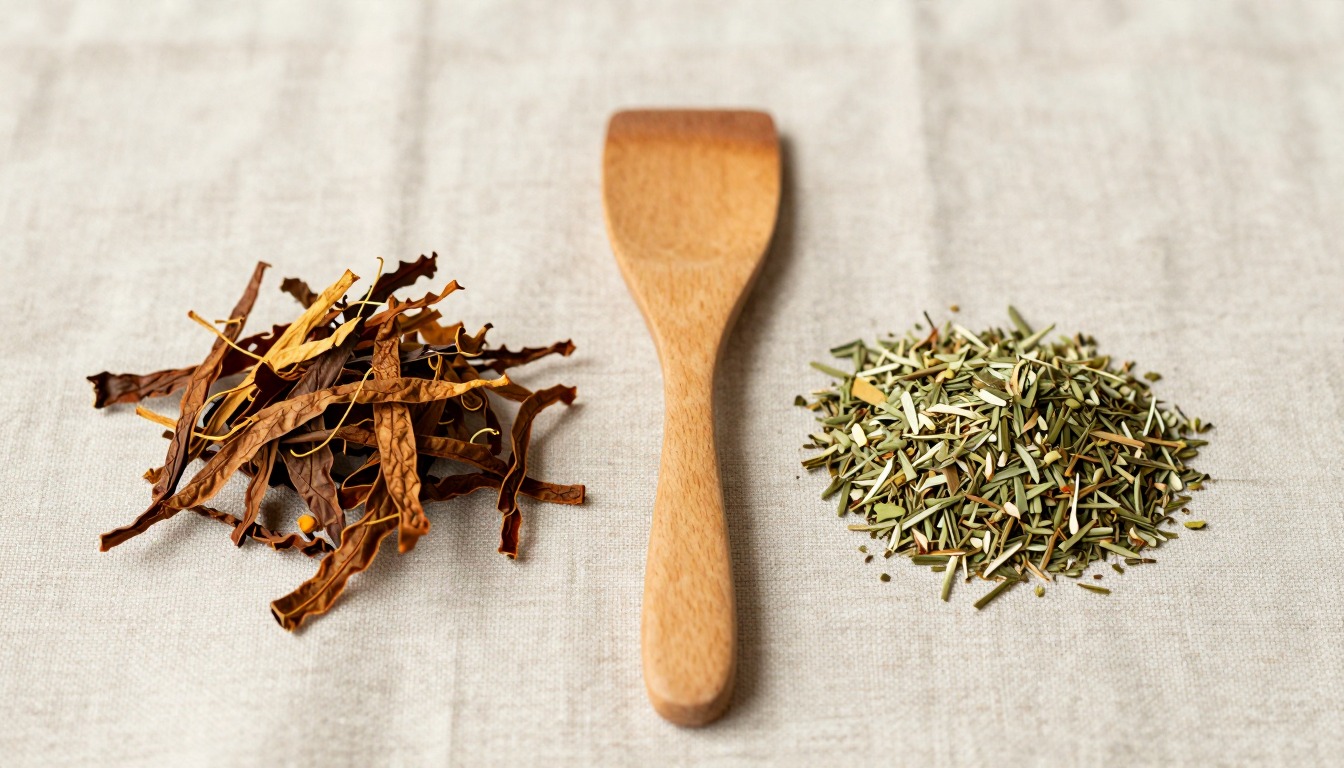
Mild and Mild Silver consist of the same seven plant ingredients: mullein leaves, blackberry leaves, lotus flower leaves, hollyhock leaves, turmeric leaves, liquorice root and liquorice leaves. They contain no tobacco and are consumed by burning.15 That fits the definition of a herbal smoking product, as we describe it in the article on the Tobacco Products Act. You will not find an assessment of our packs here. On the ingredients list: Reading the ingredients list. The range: Tobacco substitute.
Honest assessment
Status: 24 October 2026. This article reports what the cited provisions say and puts it in context. It is not legal advice. The pages accessed on gesetze-im-internet.de carry no status date of their own. We read the wording of the Directive through text reproductions, because EUR-Lex returned no text when accessed; before any use, the wording should be checked against EUR-Lex. For questions on packaging and advertising, a law firm for product law can help.
Tobacco-free does not mean risk-free. Mild and Mild Silver are not a health product and not a means of quitting smoking. Anyone who wants to stop will find free advice at rauchfrei-info.de, the portal of the German Federal Institute for Public Health, and by telephone on 0800 8 31 31 31.14 Ritual Herbs is aimed at adults.
The blends in the shop
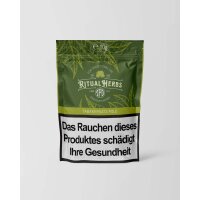
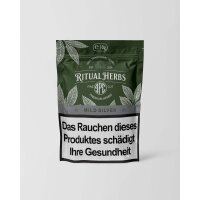

Frequently asked questions
„Das Rauchen dieses Produkts schädigt Ihre Gesundheit.“ This is required for herbal smoking products by § 30 para. 1 TabakerzV, with the same wording as Article 21 para. 1 of Directive 2014/40/EU. It belongs on the pack and the outer packaging, on the outer front and back each time. Whether a product is nicotine-free makes no difference.6, 8
According to the wording, no. § 14 TabakerzV regulates combined text-and-picture warnings expressly only for these products:
„bei Zigaretten, Tabak zum Selbstdrehen und Wasserpfeifentabak“
Our translation: “for cigarettes, roll-your-own tobacco and waterpipe tobacco”
The section on herbal smoking products consists only of § 29 (notification duties) and § 30, and § 30 prescribes only the text warning.6, 3
Among the banned elements, Article 13 para. 1 point (b) lists:
„natürliche oder ökologische Eigenschaften“
Our translation: “natural or organic properties”
Article 21 para. 4 expressly declares this point applicable to packs of herbal smoking products.8, 9 Whether a particular imprint falls under it is a legal question in each individual case.
Sources
Legal texts accessed on 24 October 2026. German laws are cited under their German titles, with an English gloss in brackets.
- Tabakerzeugnisgesetz (TabakerzG; Tobacco Products Act), § 17 Pflanzliche Raucherzeugnisse (herbal smoking products): gesetze-im-internet.de/tabakerzg/__17.
- TabakerzG § 18 Verbote zum Schutz vor Täuschung (bans to protect against deception; paras. 2 and 5): gesetze-im-internet.de/tabakerzg/__18.
- TabakerzV § 14 Kombinierte Text-Bild-Warnhinweise bei Zigaretten, Tabak zum Selbstdrehen und Wasserpfeifentabak (combined text-and-picture warnings for cigarettes, roll-your-own tobacco and waterpipe tobacco): gesetze-im-internet.de/tabakerzv/__14.
- TabakerzG § 35 Bußgeldvorschriften (provisions on administrative fines): gesetze-im-internet.de/tabakerzg/__35.
- Verordnung über Tabakerzeugnisse und verwandte Erzeugnisse (TabakerzV; Ordinance on Tobacco Products and Related Products), table of contents: gesetze-im-internet.de/tabakerzv.
- TabakerzV § 30 Warnhinweis (warning): gesetze-im-internet.de/tabakerzv/__30.
- TabakerzV § 13 Allgemeiner Warnhinweis und Informationsbotschaft (general warning and information message): gesetze-im-internet.de/tabakerzv/__13.
- Directive 2014/40/EU, Art. 21 Herbal smoking products. Official publication on EUR-Lex (no text content when accessed); read via the text reproductions gesetze.legal (German) and legislation.gov.uk (English).
- Directive 2014/40/EU, Art. 13 Product presentation: gesetze.legal (German), legislation.gov.uk (English).
- Directive 2014/40/EU, Art. 2 no. 15: gesetze.legal/eu/rl_2014_40_eu/2.
- Directive 2014/40/EU, Art. 9 para. 4: gesetze.legal/eu/rl_2014_40_eu/9.
- Abdel Rahman RT, Kamal N, Mediani A, Farag MA: How Do Herbal Cigarettes Compare To Tobacco? ACS Omega 7(50):45797 ff., 2022 (full title: “How Do Herbal Cigarettes Compare To Tobacco? A Comprehensive Review of Their Sensory Characters, Phytochemicals, and Functional Properties”). PMC9773184 (abstract).
- Bak JH, Lee SM, Lim HB: Safety assessment of mainstream smoke of herbal cigarette. Toxicological Research 31(1):41–48, 2015. doi:10.5487/tr.2015.31.1.041 (abstract via Europe PMC).
- Federal Institute for Public Health (Bundesinstitut für Öffentliche Gesundheit): rauchfrei-info.de.
- Ritual Herbs: product pages Mild and Mild Silver (ingredients), as of October 2026.
x
Please sign in to write a comment.