Key points
- The tobacco plant belongs to the genus Nicotiana with about 75 species and thus to the nightshade family (Solanaceae), like potato and tomato.1, 4
- Only two species matter economically: Virginia tobacco (N. tabacum) and Aztec tobacco (N. rustica). The remaining species, many of them ornamentals, play no role as tobacco.1
- According to current research, nicotine is formed in the roots and travels through the xylem into the leaves.1, 6
- German customs describes tobacco products made from home-grown tobacco for personal use as tax-free; any passing on to others is not permitted.8
- Mild and Mild Silver contain no tobacco plant and no nicotine, but smoke is still smoke.
Table of contents
- Loading...
The tobacco plant is not a single species but a whole genus. Behind it stands the genus Nicotiana with about 75 species, of which only two are grown as tobacco. Here is what can be backed up botanically: relatives, origin, the path of nicotine through the plant, the ornamental species in the garden and the tax position on home growing.
What is the tobacco plant? The genus Nicotiana
Briefly answered: What does the tobacco plant mean botanically?
“Tobacco plant” usually means Virginia tobacco (Nicotiana tabacum). It belongs to the genus Nicotiana in the nightshade family (Solanaceae). The genus comprises about 75 species, divided into 13 sections.1
- Genus: Nicotiana, established in 1753 by Carl von Linné in Species Plantarum1
- Family: nightshades (Solanaceae)
- Number of species: about 751, 5
- Growth form: from small annual or perennial herbs (0.1 to 0.3 m) to shrubs up to 2 m, rarely small trees up to 10 m1
- Leaf: alternate, mostly 8 to 15 cm long (range 2 to 100 cm)1
- Flower: hermaphrodite, five-parted, corolla 5 to 90 mm long, colour varies widely1
- In our blends: not included
The genus name recalls Jean Nicot (1539–1604). In 1560, as consul in Lisbon, the French diplomat sent tobacco seeds to France.1 The plant itself is far older than the name; its home is in the Americas.
Nightshades: the family
The Solanaceae include roughly 90 to 100 genera. How many species there are depends on the source: German Wikipedia gives estimates between about 2,300 and 10,000, and a figure from 2007 is 2,716.4 Well-known members are potato (Solanum tuberosum), tomato (S. lycopersicum), pepper (Capsicum) and aubergine (S. melongena).4 The greatest diversity is found in South America.4
The family stands out for its alkaloids, nitrogen-containing plant compounds.4 Nicotine is one of them. In a study of 64 Nicotiana species, it was among the most abundant alkaloids in 54 of them; we only know this figure from Wikipedia, not from the study itself.1
Where does the tobacco plant come from?
The genus occurs in three separate regions. Most species grow in South America, the second-largest number in Australia and the South Pacific, the third-largest in North America. One species is known from Africa, Nicotiana africana, which is related to the Australian species.1
Virginia tobacco probably arose in western South America. It is a so-called allotetraploid hybrid, that is, a natural cross between two species with a doubled set of chromosomes (2n = 48). The maternal parent is considered to be Nicotiana sylvestris, the paternal one Nicotiana tomentosiformis.2, 5 It reached Central America and Mexico even before Columbus.2
Aztec tobacco originally comes from the Amazon region; occurrences are described from Bolivia, Peru and Ecuador. It has been grown in Europe since the Thirty Years’ War (1618–1648).3 Its parents were long disputed; a 2020 analysis of plastid genomes sees the common ancestor of N. paniculata and N. knightiana as the maternal parent.5
Two species, one comparison
Only N. tabacum and N. rustica are of economic importance. Virginia tobacco is by far the more common species, while Aztec tobacco is only grown occasionally.1 The two are easy to tell apart even from a distance:
| Virginia tobacco | Aztec tobacco | |
|---|---|---|
| Botanical name | Nicotiana tabacum | Nicotiana rustica |
| Height | mostly 0.7 to 2 m, rarely up to 3 m | mostly 40 to 60 cm, occasionally up to about 120 cm |
| Leaf blade | up to about 70 cm long, stickily glandular-hairy | no information in our source |
| Flower | corolla tube 3.5 to 4.5 cm long; July to October in Central Europe | greenish-yellow, corolla 1.2 to 2.2 cm; June to September in Germany |
| Nicotine, dried leaf (cultivated forms) | mostly 0.5 to 8 %, maximum up to 10 % | mostly 0.5 to 8 %, maximum up to 18 % |
| Probable home | western South America | Amazon region |
| Source | [1], [2] | [1], [3] |
Where is nicotine formed in the plant?
Briefly answered: Where does the tobacco plant make nicotine?
The tobacco plant makes nicotine in its roots. In N. tabacum, according to the literature, nicotine is formed in the root tissues. From the root the compound travels through the xylem, the water-conducting vessels, into the leaves and is stored in the vacuoles of the leaf cells.1, 6
The route was described, among others, by a research group around Masahiro Morita in the Proceedings of the National Academy of Sciences (2009). The first key enzyme of nicotine formation, putrescine N-methyltransferase, is produced specifically in the pericycle of the root, not in the above-ground parts. The nicotine is released from the root cells into the vessels, reaches the cells of the leaf tissue and is deposited in their vacuoles. For this the authors describe a transporter of the MATE type (multidrug and toxic compound extrusion).6
The source also touches on why the plant does this: formation in the root increases when pathogens, herbivores or injuries put the plant under stress, mostly via the messenger jasmonate.6 So nicotine apparently serves the plant as part of its defence. The route crosses several membranes; not all transporters have been identified.6
The Poison Information Centre in Bonn classes Virginia tobacco as very poisonous, all parts of the plant. The main active compound is nicotine, along with nornicotine, anabasine and nicotyrine. The content of the leaves varies greatly. If you would like to know more about the history of the compound, you will find it in What is nicotine?7
Ornamental tobacco in the garden
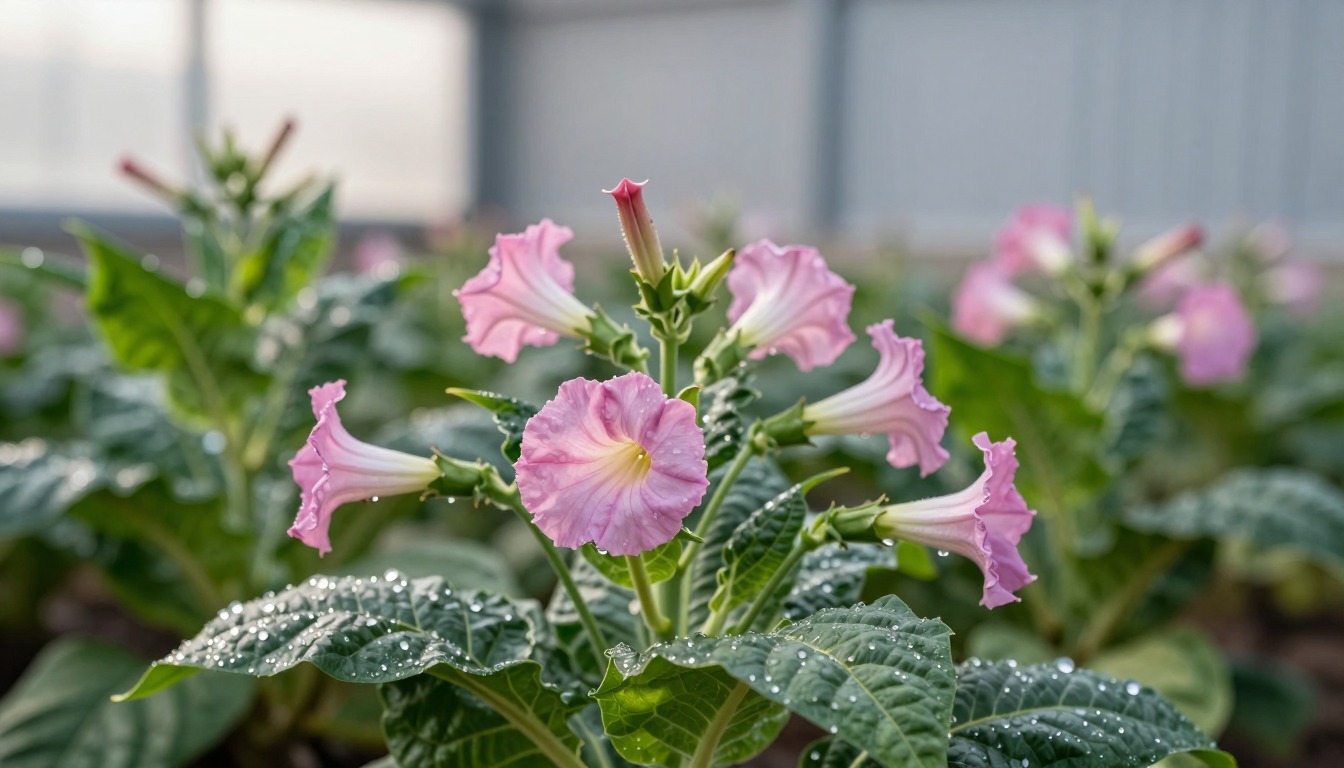
The genus also has a quiet side. Woodland tobacco (Nicotiana sylvestris) grows up to 1.7 m tall, bears long white flower tubes and smells strongly at night.1 It is also the maternal parent of Virginia tobacco.5 The cross Nicotiana × sanderae from N. forgetiana and N. alata is also planted as ornamental tobacco. The cultivar ‘Scharlachkönig’ (‘Scarlet King’) flowers dark red and grows to about 60 cm.1
That ornamental species are not tobacco does not mean they are harmless. As described above, nicotine is a common alkaloid in most of the species studied in the genus.1 We found no separate classification for ornamental tobacco from the Poison Information Centre in Bonn. In a garden with children or pets, the same applies as for any plant you cannot identify with certainty: do not eat it, do not chew it. If you have questions, the Bonn poison helpline is available around the clock on +49 228 19240.7
Growing tobacco plants yourself: what does customs say?
Briefly answered: Is growing tobacco in your own garden taxable?
According to German customs, tobacco products made from home-grown tobacco are tax-free if they are intended for personal use. No notification to customs or permit is needed for this. Any passing on to others, even free of charge, is not permitted; tobacco tax is then due, and an administrative offence or criminal offence may be involved.8
Customs names no fixed maximum quantity. The amount depends on personal consumption.8 We do not explain how to grow, dry or process tobacco here. This section only reports the tax information from German customs and is not legal advice. For an individual case, the competent main customs office is the right contact.
The tobacco plant and Ritual Herbs
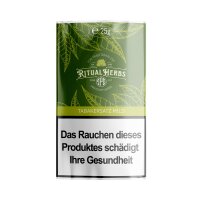
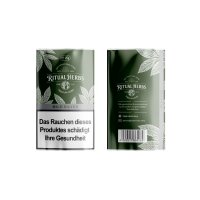
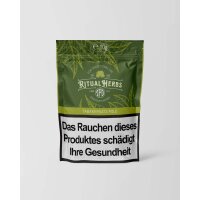
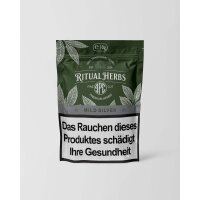
Mild and Mild Silver contain the same seven plant ingredients: mullein leaves, blackberry leaves, lotus flower petals, hollyhock leaves, turmeric leaves, liquorice root and liquorice leaves. No Nicotiana species is among them. Both varieties are free of tobacco and free of nicotine, and the ingredients are listed in full on the pack. They are processed in Germany, and the cut is tuned for a calm burn.
Which plants suit a range like this is covered in Which herbs can you smoke?, and the comparison with tobacco in Tobacco substitute: herbal blend. You can find the range under Tobacco substitute.
Mild and Mild Silver: the varieties in the shop
Frequently asked questions
The genus is called Nicotiana and belongs to the nightshade family. The species grown as tobacco are mainly Nicotiana tabacum (Virginia tobacco) and, less often, Nicotiana rustica (Aztec tobacco). In total the genus comprises about 75 species.1
Yes. The Poison Information Centre in Bonn classes Virginia tobacco as very poisonous, all parts of the plant. The main active compound is nicotine. The Bonn emergency line can be reached around the clock on +49 228 19240.7
German customs describes tobacco products from home-grown tobacco for personal use as tax-free; no notification or permit is needed. Passing them on is not permitted. This is the tax information, not legal advice. If in doubt, the main customs office can help.8
No. Mild and Mild Silver consist of the same seven plant ingredients: mullein leaves, blackberry leaves, lotus flower petals, hollyhock leaves, turmeric leaves, liquorice root and liquorice leaves. They are tobacco-free and nicotine-free.
Honest assessment
Tobacco-free does not mean risk-free. Smoke from plant material contains combustion products. The review in ACS Omega (2022) lists carbon monoxide, polycyclic aromatic compounds and N-nitrosamines, among others.9 A Korean study (2015) found more carbon monoxide and benzo[a]pyrene in the smoke of a nicotine-free herbal cigarette than in a tobacco cigarette with a similar tar content; the smoke condensate was more strongly mutagenic. This concerns a single product, but it shows that “nicotine-free” is not a free pass.10
With Mild and Mild Silver, tobacco and nicotine are left out. We claim nothing more. They are not a health product and not a means of quitting smoking. If you want to stop, you can find free counselling at rauchfrei-info.de, the portal of the Federal Institute for Public Health (in German), and by phone on 0800 8 31 31 31 (in Germany).11 Ritual Herbs is aimed at adults.
What we do not know: the number of species in the genus varies depending on the source and the classification, and in the transport of nicotine, according to the literature, not all of the transporters involved have been identified.1, 6
Keep reading
Sources
- Wikipedia (de): Tabak (Gattung). Retrieved October 2026. Number of species, sections, distribution, growth forms, nicotine content, ornamental species, Jean Nicot.
- Wikipedia (de): Virginischer Tobacco. Retrieved October 2026. Hybrid origin, home, height, flower.
- Wikipedia (de): Bauern-Tobacco. Retrieved October 2026. Home, height, flower, cultivation in Europe.
- Wikipedia (de): Nachtschattengewächse. Retrieved October 2026. Number of genera and species, crop plants, alkaloids, distribution.
- Mehmood F, Abdullah, Ubaid Z, Shahzadi I, Ahmed I, Waheed MT, Poczai P, Mirza B: Plastid genomics of Nicotiana (Solanaceae): insights into molecular evolution, positive selection and the origin of the maternal genome of Aztec tobacco (Nicotiana rustica). PeerJ 8:e9552, 2020. PMC7382938.
- Morita M, Shitan N, Sawada K, Van Montagu MCE, Inzé D, Rischer H, Goossens A, Oksman-Caldentey KM, Moriyama Y, Yazaki K: Vacuolar transport of nicotine is mediated by a multidrug and toxic compound extrusion (MATE) transporter in Nicotiana tabacum. Proc Natl Acad Sci U S A 106(7):2447–2452, 2009. PMC2650162.
- Poison Information Centre, University Hospital Bonn: Tobacco, Virginia (Nicotiana tabacum). Retrieved October 2026. Toxicity, constituents, emergency line.
- German customs (Zoll): Tobacco. Retrieved October 2026. Home growing, tax exemption, passing on, no notification duty.
- Abdel Rahman RT, Kamal N, Mediani A, Farag MA: How Do Herbal Cigarettes Compare To Tobacco? ACS Omega 7(50), 2022. PMC9773184.
- Bak JH, Lee SM, Lim HB: Safety assessment of mainstream smoke of herbal cigarette. Toxicological Research 31(1):41–48, 2015. doi:10.5487/tr.2015.31.1.041.
- Federal Institute for Public Health (BIÖG): rauchfrei-info.de. Retrieved October 2026.


x
Please sign in to write a comment.