Key points
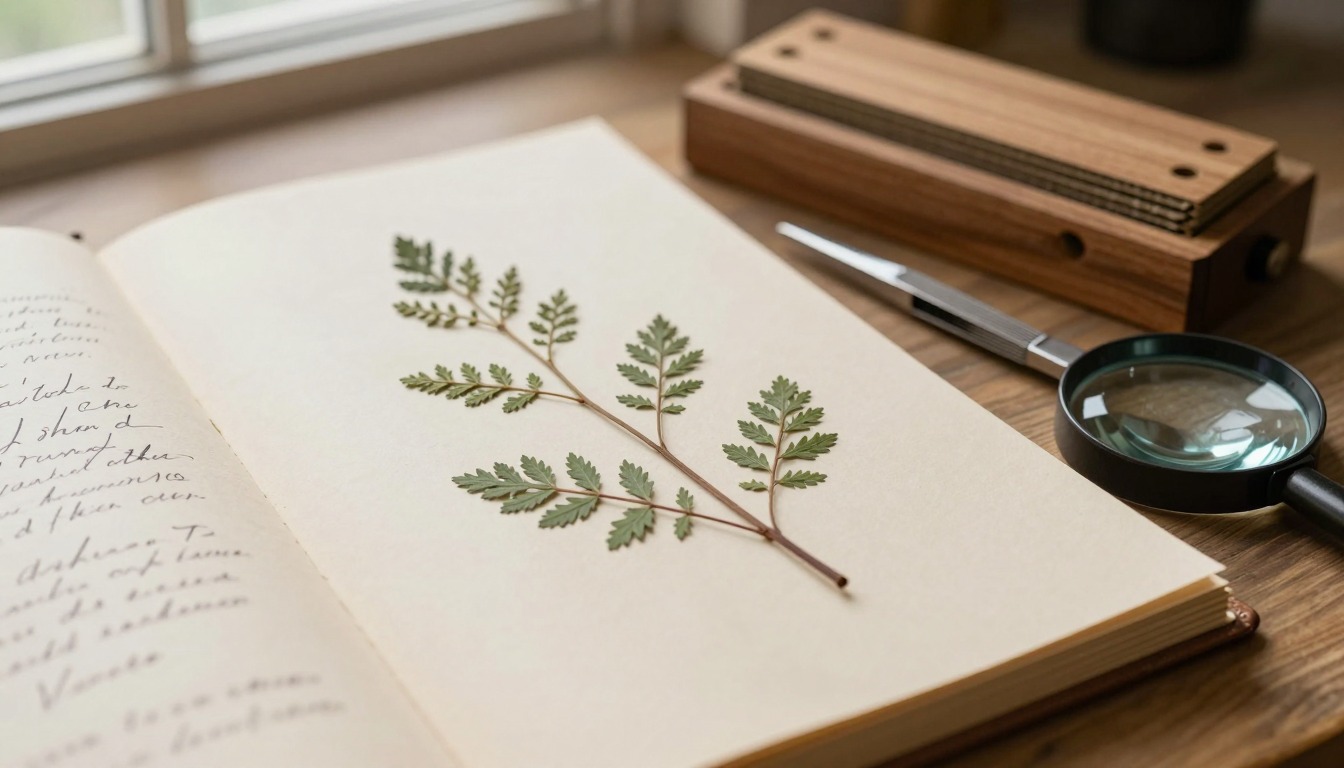
- A herbarium is a collection of pressed, dried plants. Each specimen sits on its own sheet, with a label giving place, date and collector.
- Plants are pressed between corrugated cardboard and blotting paper. The RHS Herbarium gives a drying time of two days to three weeks and a first change of paper after 24 hours.
- Under § 44 of the German Federal Nature Conservation Act (BNatSchG), specially protected plant species must not be taken from the wild, for example yellow gentian, arnica or primroses (wild populations in each case).
- A herbarium is documentation, not a stock to use. We give no instructions for smoking herbarium material.
Table of contents
- Loading...
Making a herbarium takes mostly patience and dry paper. The craft consists of collecting, pressing, labelling, mounting and dry storage. Here is how the herbarium of the Royal Horticultural Society (RHS) and two universities go about it, and what the Federal Nature Conservation Act requires when you collect.
Why make a herbarium, and what is it?
Quick answer: What is a herbarium?
A herbarium is a way of documenting formerly living plants in pressed and dried form. The plants are mounted on card and given the necessary identification data.4 A single specimen is a dried plant or plant part, collected and preserved “for documentation and study purposes”.5
How do you collect plants for a herbarium?
The RHS Herbarium advises choosing a typical, healthy plant rather than the largest one, plus two or three extra flowers for additions. You shake off the soil, and you do not collect in wet weather. Take a photo of the growth habit on site and a close-up, and note what gets lost in pressing: overall size, growth form and scent.1 These notes belong on the label later. They cannot be reconstructed afterwards.
Which plants must you not collect?
Quick answer: May I collect protected plants for a herbarium?
No. Under § 44 (1) no. 4 of the Federal Nature Conservation Act, it is forbidden to take wild plants of specially protected species from the wild or to damage them or their sites.7 For all other wild plants, § 39 (3) allows careful removal in small quantities for personal use at places where entry is not prohibited.6
Which species count as “specially protected” is set out in § 7 (2) no. 13 BNatSchG, among other things through Annexes A and B of EC Regulation 338/97 and through statutory ordinances under § 54 BNatSchG.8 Annex 1 of the Federal Species Protection Ordinance (BArtSchV) gives the protection status. Here is a selection we checked there (“wild populations only” applies to each of the four rows):
| Plant | Entry in Annex 1 BArtSchV |
|---|---|
| Yellow gentian (Gentiana lutea) and all European gentians (Gentiana spp.) | specially protected, all European species (with exceptions given in the footnote) |
| Arnica, mountain arnica (Arnica montana) | specially protected |
| Primulas, primroses (Primula spp.) | specially protected, all European species (with exceptions given in the footnote) |
| Yew (Taxus baccata) | specially protected |
| Source | 11 |
This is only a selection. Before you cut, check whether a species is protected in WISIA-online, the database of the Federal Agency for Nature Conservation (BfN). The BfN itself points out that in case of doubt the legal texts and their annexes are authoritative.12 In nature reserves, § 23 BNatSchG prohibits actions that may destroy, damage or alter the area or its components.10
There are exceptions: under § 45 (7) BNatSchG, the competent authority may allow exceptions in individual cases “for purposes of research, teaching, education or reintroduction” if there is no reasonable alternative and the conservation status does not worsen.9 We have not found out whether a private herbarium falls under this; if in doubt, ask the nature conservation authority. For protected species, the photo is what you keep. The handful rule, closed seasons and collecting limits are covered in Foraging wild herbs: what is allowed?, identification aids in Identifying plants: features, books and apps. A plant you do not know for certain, you leave standing.
How do you press plants?
Quick answer: How do you press plants for a herbarium?
The plant lies between blotting paper, with a layer of corrugated cardboard above and below, and the press of two boards (about 40 × 30 cm) is weighed down or strapped. After 24 hours the RHS Herbarium replaces the corrugated cardboard and the top layer of blotting paper with dry cardboard; depending on the plant, drying takes between two days and three weeks.1
Schritt 1
Prepare.
With dense specimens, thin out leaves and flowers without losing the character of the plant.
Schritt 2
Layer.
From the bottom: corrugated cardboard, two sheets of blotting paper, plant, two sheets of blotting paper, corrugated cardboard. For thick or fleshy samples, a foam sheet goes between the blotting paper and the cardboard.
Schritt 3
Weigh down or strap.
Put the top board on and weigh it down evenly (bricks, heavy books) or tighten it with straps.
Schritt 4
Store warm.
In a drying cabinet, airing cupboard or a dry room above the heating.
Schritt 5
Change after 24 hours.
The corrugated cardboard and the top layer of blotting paper are replaced with dry card. According to the RHS, this is the last chance to rearrange the plant.
Schritt 6
Check.
At least once a week, until the specimen is dry.
The six steps follow the RHS Herbarium.1
Quick drying prevents discolouration and mould. Without a drying cabinet, the University of Reading recommends opening the presses daily and changing the drying papers.2 The Erlangen herbarium heats the press; by its own account it reproduces the method of Weber (GFR 1977/4) only in excerpts and in modified form. The set-ups differ in materials:
| RHS Herbarium | Herbarium Erlangen (after Weber, modified) | |
|---|---|---|
| Layers | corrugated cardboard, blotting paper | felt board (42.5 × 29.5 cm), corrugated cardboard, tissue paper as a wrapper |
| Cover | two boards, about 40 × 30 cm | two plywood sheets, 10 mm, 44 × 31 cm |
| Clamping | straps or weight | two suitcase straps, up to about 50 layers |
| Heat | warm, dry room | infrared heater, 100 watts (“no higher output”) |
| Source | [1] | [3] |
The Erlangen press stands upside down on a stool so that the air channels of the corrugated cardboard run vertically.3 That is an institutional solution, not a recommendation for the home. For drying plants for other purposes: Harvesting and drying herbs: timing, place, craft.
What goes on the label, and how do you mount the specimen?
Mounting: sheet, glue, tape
The RHS Herbarium mounts on acid-free paper in the format 419 × 266 mm; at home, acid-free A4 will do. Specimens are fixed with pH-neutral PVA glue and gummed linen tape.1 The University of Reading places dots of PVA glue at suitable points on the stems; small lead weights on the plant help the bond set firmly. Large seeds go into a small envelope on the sheet.2
How do you store a herbarium?
Quick answer: How do you protect a herbarium from pests?
The RHS Herbarium freezes each specimen in a sealed plastic bag for 72 hours. Ideal is −32 °C; household freezers usually reach only −18 °C. The most common pest is the drugstore beetle (Stegobium paniceum); the freezing is repeated every six months.1
According to the RHS Herbarium, freezing is the only method against pests. On top of that comes regular checking for infestation and damage.1 How long a private herbarium lasts with this care, we have not found out.
Herbarium and blend: the same care, a different goal
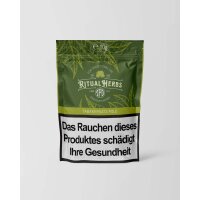
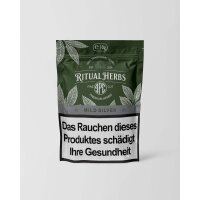
A herbarium and an herbal blend have one thing in common: moisture decides. With a herbarium specimen, quick drying prevents discolouration and mould.2 With Mild and Mild Silver, cut and residual moisture decide how the blend burns: too dry and it burns through hard, too moist and it goes out. That is why the pouches are resealable. Both varieties consist of the same seven plant ingredients: mullein leaves, blackberry leaves, lotus flower leaves, hollyhock leaves, turmeric leaves, liquorice root and liquorice leaves. Portraits of the plants are in The seven ingredients of Mild; you will find the range under tobacco substitute.
Smoke is smoke. A herbarium specimen is documentation and not a stock, and we give no instructions for smoking collected or pressed plants. A review in ACS Omega (2022) lists carbon monoxide, polyaromatic compounds and N-nitrosamines among the hazardous compounds in herbal cigarettes.13 Which plants do not belong in any smoking blend, for good reason, is covered in These plants do not belong in a smoking blend.
Mild and Mild Silver: the blends in the shop
Frequently asked questions
The RHS Herbarium gives between two days and three weeks, depending on the plant and conditions. After 24 hours you replace the corrugated cardboard and the top blotting paper with dry ones, then you check at least once a week. Only when the specimen is dry does it go onto the sheet.1
Plant name with author, family, a description of the features that are lost in pressing, place of collection, date and collector. The label sits at the bottom right of the sheet.1
Specially protected species, for example yellow gentian, arnica (wild populations), primulas and yew according to Annex 1 of the Federal Species Protection Ordinance. Under § 44 BNatSchG, taking them from the wild is forbidden. Check every species beforehand in the BfN's WISIA-online. Additional prohibitions apply in nature reserves.7, 10, 11, 12
Put each specimen in a sealed plastic bag and freeze it for 72 hours, repeating every six months. Ideal is −32 °C; a household freezer usually reaches −18 °C. The most common pest is the drugstore beetle. On top of that, check regularly for infestation.1
An honest assessment
Tobacco-free does not mean risk-free. Smoke from plant material contains combustion products such as carbon monoxide. It is produced by incomplete combustion and, according to the German Environment Agency, binds to haemoglobin about 200 times more strongly than oxygen.15
A study (2015) found more carbon monoxide and benzo[a]pyrene in the smoke of an herbal cigarette without detectable nicotine than in the smoke of a tobacco cigarette with the same tar content; the smoke condensate was more mutagenic in the test. That concerns a single product, but it shows that “nicotine-free” is not a free pass.14
With Mild and Mild Silver, tobacco and nicotine are left out. We claim nothing more. They are not a health product and not a means of quitting smoking. If you want to stop, you can find free counselling at rauchfrei-info.de (in German), the portal of the Federal Institute for Public Health, and by phone on 0800 8 31 31 31 (in Germany).16 Ritual Herbs is aimed at adults.
What we do not know: the pressing details come from three guides (RHS, Reading, Erlangen) that differ in details. We have not found an official German standard for herbarium specimens, and we have not checked the legal situation in the individual federal states.
Read more
Sources
- Royal Horticultural Society: Pressing and collecting samples (RHS Herbarium). Retrieved October 2026. Collecting, notes, press, change of paper, drying time, label, sheet, glue, freezing.
- University of Reading, Herbarium: How to make a Herbarium Specimen. Retrieved October 2026. Change of paper, mounting, label position.
- Herbarium Erlangense, Friedrich-Alexander-Universität Erlangen-Nürnberg (in German): Anlegen eines Herbars. Retrieved October 2026. Pressing method after Weber (GFR 1977/4).
- Philipps-Universität Marburg, Botanical Garden (in German): Herbarium des Botanischen Gartens. Retrieved October 2026. Definition of a herbarium.
- Europäische Geschichte Online (University of Trier), media database, image from the Neuchâtel herbarium (in German): Herbarbeleg: Getrocknetes und gepresstes Exemplar eines Wald-Frauenfarns. Retrieved October 2026. Term herbarium specimen, purpose.
- Federal Nature Conservation Act (BNatSchG, in German), § 39 Allgemeiner Schutz wild lebender Tiere und Pflanzen, para. 1 no. 2 and para. 3. Retrieved October 2026.
- BNatSchG, § 44 Vorschriften für besonders geschützte und bestimmte andere Tier- und Pflanzenarten, para. 1 no. 4. Retrieved October 2026.
- BNatSchG, § 7 Begriffsbestimmungen, para. 2 no. 13. Retrieved October 2026.
- BNatSchG, § 45 Ausnahmen, para. 7. Retrieved October 2026.
- BNatSchG, § 23 Naturschutzgebiete, para. 2. Retrieved October 2026.
- Federal Species Protection Ordinance (BArtSchV, in German), Anlage 1 Schutzstatus wild lebender Tier- und Pflanzenarten. Retrieved October 2026.
- Federal Agency for Nature Conservation (BfN): WISIA-online. Retrieved October 2026. Operator, purpose, note on the authority of the legal texts.
- Abdel Rahman RT, Kamal N, Mediani A, Farag MA: How Do Herbal Cigarettes Compare To Tobacco? ACS Omega 7(50):45797–45809, 2022. PMC9773184.
- Bak JH, Lee SM, Lim HB: Safety assessment of mainstream smoke of herbal cigarette. Toxicological Research 31(1):41–48, 2015. doi:10.5487/tr.2015.31.1.041. Retrieved October 2026 (abstract).
- German Environment Agency (Umweltbundesamt, in German): Kohlenmonoxid. Retrieved October 2026. Formation in incomplete combustion, binding to haemoglobin.
- Federal Institute for Public Health (in German): rauchfrei-info.de. Retrieved October 2026.

x
Please sign in to write a comment.