The key points
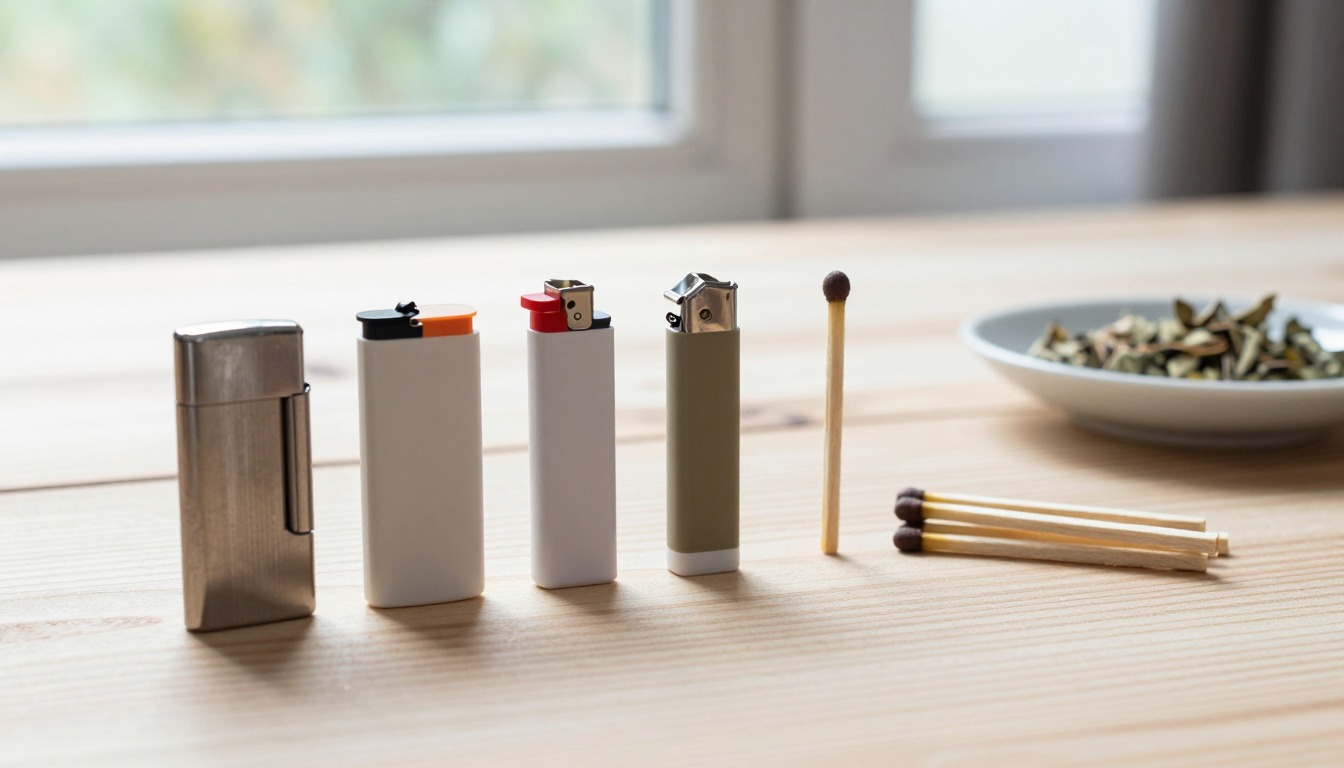
- The common ignition sources are the friction wheel, piezo, jet lighter, arc and match. They differ in how they ignite, in flame shape and in fuel.1
- A yellow flame glows because of incandescent soot particles, a blue one burns with little soot. An arc lighter has no fuel flame at all.1, 4
- As far as our research goes, nobody has studied how the flame affects fine herbal blends. What is documented is that cut and residual moisture shape the burn.6
- In 2006 the European Commission made child-resistant lighters mandatory. Matches and lighters still belong in a place children cannot reach.7, 9
- Even nicotine-free herbal smoke is smoke: it contains combustion products such as carbon monoxide.10, 11
Table of contents
- Loading...
There are more kinds of lighters than most kitchen drawers let on. Whoever lights a fine herbal blend holds, depending on the device, a yellow gas flame, a blue jet, a match or an arc to it. This article explains how the common ignition sources work, what can be documented about their flames, where our research ends and what matters for fire safety. We do not recommend any brand.
Which types of lighters are there?
In short: Which types of lighters are there?
A lighter is a handheld device for producing a flame. It is ignited by sparks from a friction wheel on a flint or piezoelectrically; arc lighters, which work without fuel, are a further type. Common fuels are petrol, butane and propane.1
For everyday use, five ignition sources can be told apart:
| Ignition source | How it works | Flame | Fuel / energy |
|---|---|---|---|
| Friction wheel | The wheel scrapes shavings off the flint, which ignite in the air1 | yellow, blue-yellow or blue, depending on the burner | petrol, butane or propane |
| Piezo | A striker hits a piezoelectric body; the voltage in the kilovolt range triggers a spark1, 2 | depends on the burner | as with the friction wheel; no flint needed |
| Jet | Air is mixed in at the nozzle inlet (premix burner)1 | long, thin, blue, non-luminous1 | gas |
| Match | The head ignites on the striking surface containing red phosphorus5 | flame of a burning wooden stick | wooden shaft dipped in paraffin |
| Arc | High voltage creates an electric arc between electrodes1 | no fuel flame | battery power |
Friction wheel, piezo, arc: how is the spark made?
In a friction wheel lighter, the knurled wheel makes the spark. Today's flints are made of ferrocerium (auer metal), not of flint stone. The shavings of this alloy are pyrophoric, meaning they ignite on contact with air.1 Carl Auer von Welsbach invented the lighter flint in 1903; Treibacher Industrie AG, the company he founded, still makes it today.3
A piezo lighter needs no flint. A tensioned spring snaps a striker against a piezoelectric body. The impact deforms the material, a voltage builds up, and a spark jumps between two metal contacts.1, 2 How high the voltage is depends on the component; the usual order of magnitude is a few kilovolts.1
An arc lighter needs neither flint nor gas. It creates an electric arc between electrodes, which can ignite easily flammable material such as a wick.1 We found no source stating whether an arc ignites fine plant material on its own.
Yellow or blue: what does the flame tell you?
In short: Why are some flames yellow and others blue?
A flame glows yellow to orange because of incandescent soot particles. Blue comes from excited CH radicals and CO₂. When oxygen is short, mostly soot forms, which causes the intense glow; with an excess of oxygen the flame glows only faintly.4
For gas lighters, three burner types are distinguished. In a diffusion burner the air joins from outside and the flame is bright yellow. A partial premix burner draws in air through a coil spring and burns blue-yellow. A premix burner takes in the air right at the nozzle inlet.1 This fits the general distinction: in a premixed flame the mixture is homogeneous before combustion, whereas in a diffusion flame fuel and oxygen are brought together separately, as with a candle.4 In a petrol lighter, a wick carries the fuel to the ignition point by capillary action.1
We found no temperature figure for each lighter type and therefore give none. As an order of magnitude: theoretically, the combustion temperatures of hydrocarbons with air are around 2,000 kelvin; in everyday use these values are nowhere near reached.4
What is a jet lighter?
A jet lighter is a premix burner. Its flame is long, needle-thin, blue and non-luminous.1 Non-luminous means that hardly any soot particles glow and the combustion runs with plenty of air. Various designs are sold under the term "storm lighter"; we found no uniform definition. How hot a jet lighter gets compared with others depends on the model, and we have no reliable measurement.
How is a match built?
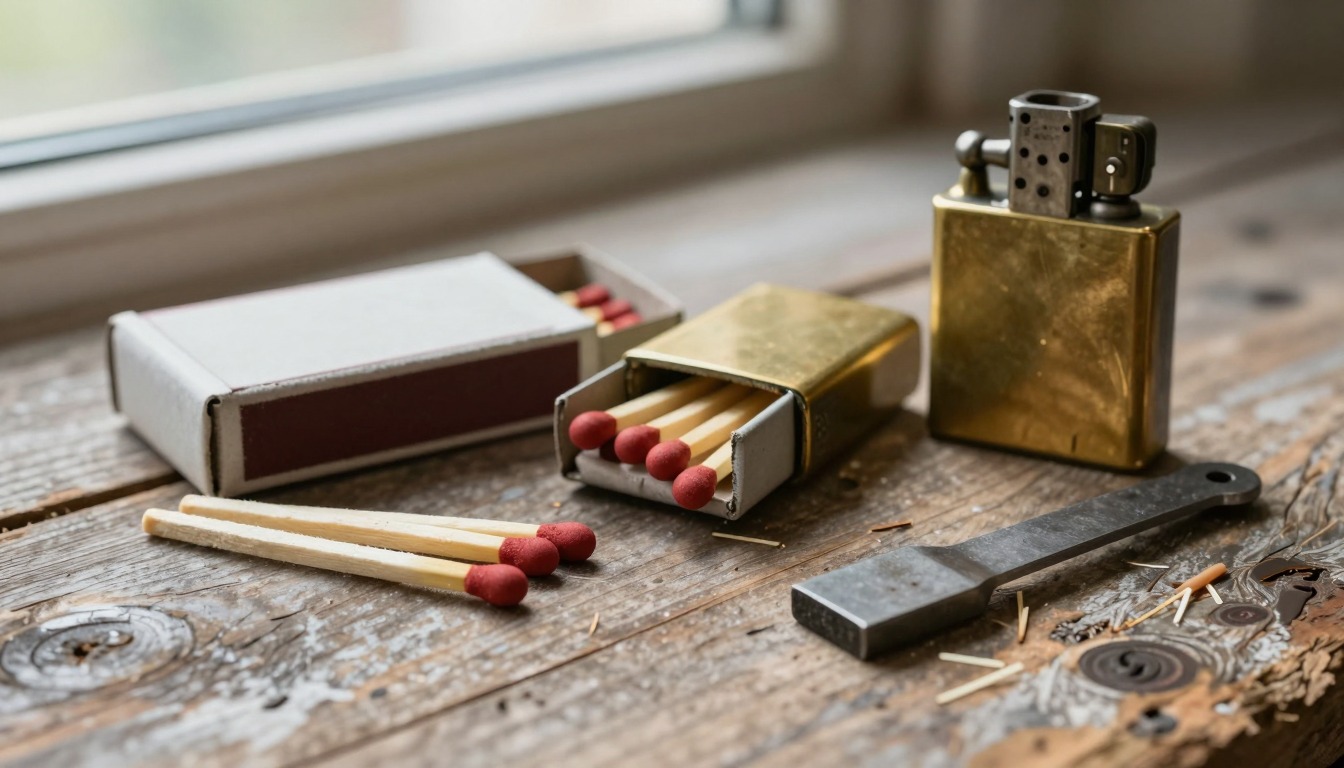
In a safety match the ignition mixture sits in two places. In one analysed sample the head consists of about 60 % potassium chlorate, plus sulfur, glass powder and binders. The striking surface on the box carries red phosphorus and glass powder.5 The wood is thin and light; the sticks are dipped in paraffin so that they burn evenly after ignition.5 The exact composition differs from manufacturer to manufacturer; the figures come from a project paper by the Institut Dr. Flad and apply to that one sample.
There is a separate article on the history from tinder to the match: From tinder to match.
How does the flame behave with fine herbal blends?
In short: Does the lighter influence the burn?
We found no study on this. What is documented concerns the material itself: blends cut too coarse form cavities and the ember travels uncontrolled; blends cut too fine burn too fast. Material that is too dry ignites at once and burns hard, material that is too moist keeps going out.6
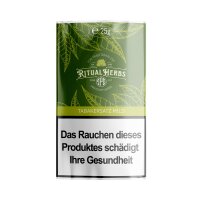
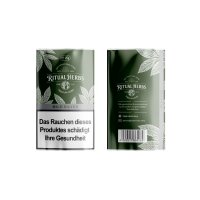
These statements come from our own product description of Mild and Mild Silver, so they are manufacturer knowledge and not an independent measurement. They explain why cut and residual moisture get so much attention with us: both varieties are cut for a consistent structure and a calm burn, and the 25 g pouch is resealable so the blend keeps its moisture.6 More in Fine cut and coarse cut: the difference and in Cutting and grinding dried herbs.
What the ignition source contributes can only be described through its properties in the sources, not through measurements on the herbs:
- A yellow flame carries soot, a blue premix flame hardly glows.1, 4
- With a match, a wooden stick soaked in paraffin burns first, before the herb catches fire.5
- Whether and how all this affects the flavour or burn of an herbal blend has, to our knowledge, not been studied. We derive no ranking from it.
What matters for fire safety when lighting up?
The German Federal Office of Civil Protection and Disaster Assistance (BBK) names falling asleep with a cigarette on upholstered furniture or in bed as one of the most common causes of fire.8 An herbal blend is no exception: it also forms an ember, and according to our product description that ember can travel uncontrolled.6
- Keep out of children's reach. The German Fire Brigades Association recommends keeping matches and lighters in a place children cannot reach.9
- Look for child resistance. In 2006, with Decision 2006/502/EC, the European Commission obliged member states to allow only child-resistant lighters on the market and to ban novelty lighters. A lighter counts as child-resistant if children under 51 months cannot operate it under normal or reasonably foreseeable conditions; the requirements and test procedures are set out in standard EN 13869. From 11 March 2008, only child-resistant lighters could be supplied to consumers.7
- Never lying down, never drowsy. That follows from the cause of fire the BBK names.8
- Smoke alarms. The BBK advises installing fire extinguishers and smoke alarms and servicing them regularly. Avoid smoke-filled rooms; if attempts to extinguish fail, call 112. According to the BBK, smoke poisoning is the most common cause of death in house fires.8
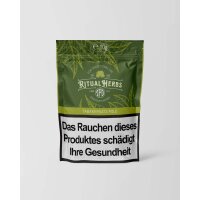
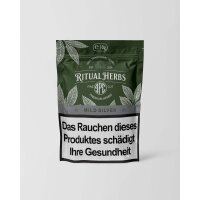
Mild and Mild Silver: the varieties in the shop
Frequently asked questions
Common types are friction wheel, piezo, jet, arc and petrol lighters, as well as the match. They differ in ignition (spark or arc), in fuel (petrol, butane, propane or battery power) and in flame. Which type suits you in a given case is for you to decide by child resistance, handling and safety, not by a ranking.1
An arc lighter uses high voltage to create an electric arc between electrodes, which can ignite easily flammable material. It needs no fuel and no flint, but it needs battery power. We found no source stating whether the arc makes fine plant material smoulder on its own.1
According to our research this has not been studied. What is documented is only that flames burn differently: yellow flames glow because of incandescent soot particles, blue premix flames hardly glow, and with a match the burning wooden shaft is added. We derive no ranking or recommendation from this because measurements on the herbs are missing.1, 4, 5
An honest assessment
Smoke stays smoke. Tobacco-free does not mean risk-free. A review in ACS Omega (2022) lists carbon monoxide and polyaromatic compounds, among others, as hazardous substances in herbal cigarettes; the authors consider herbal cigarettes at least as dangerous as normal cigarettes and themselves point out limits of their methodology.10 Carbon monoxide binds more strongly to the red blood pigment haemoglobin than oxygen does and thus blocks oxygen transport.12
A Korean study (2015) found more carbon monoxide and benzo[a]pyrene in the mainstream smoke of one herbal cigarette than in a tobacco cigarette with the same tar content; nicotine and tobacco-specific nitrosamines were not detectable. This concerns a single product.11
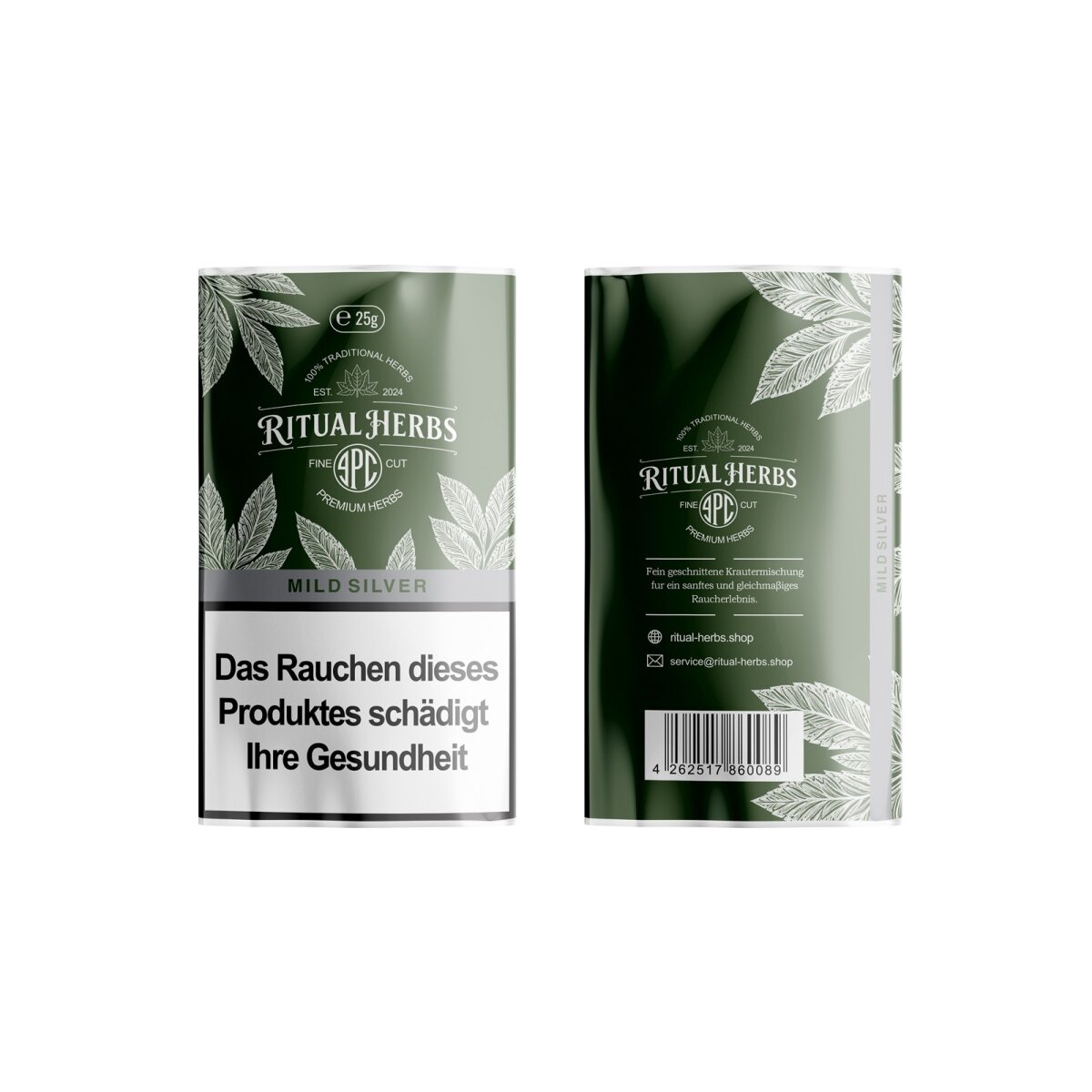
With Mild and Mild Silver, tobacco and nicotine are left out. We claim nothing more. They are not a health product and not a means of quitting smoking. If you want to quit, you can find free counselling at rauchfrei-info.de (in German), the information portal of the German Federal Institute for Public Health.13 Ritual Herbs is aimed at adults.
You can find the full range with all varieties and sizes under Tobacco substitute.
Read more
Sources
- Wikipedia (de): Feuerzeug. Retrieved 24 Oct 2026. Designs, burners, fuels, flint, piezo, arc. Secondary source, therefore used only for basic principles.
- heizung.de: Piezozuender: Funktionsweise, Einsatzgebiete und Vorteile (in German). Retrieved 24 Oct 2026. Spring, plunger, piezo element, spark (trade portal for heating technology, same principle as in a lighter).
- Treibacher Industrie AG: Flints. Retrieved 24 Oct 2026. Invention of the lighter flint by Carl Auer von Welsbach in 1903 (manufacturer's statement).
- chemie-schule.de: Flamme (in German). Retrieved 24 Oct 2026. Flame colours, soot, premix and diffusion flames, order of magnitude of temperature (chemistry encyclopedia).
- Institut Dr. Flad: Herstellung eines historischen und Analyse eines kommerziellen Zündholzes (project paper, in German). Retrieved 24 Oct 2026. Composition of one examined sample.
- Ritual Herbs: product pages Mild and Mild Silver (section "Processing and burn"), as of October 2026, at Tobacco substitute. Manufacturer's statement.
- European Commission: Decision 2006/502/EC of 11 May 2006 requiring Member States to take measures to ensure that only child-resistant lighters are placed on the market. Official text, retrieved 24 Oct 2026 in the reproduction of the UK National Archives. The deadline for supply to consumers (11 March 2008) was supplemented by Decision 2007/231/EC.
- Federal Office of Civil Protection and Disaster Assistance (BBK): Technische Gefahr: Feuer (in German). Retrieved 24 Oct 2026.
- German Fire Brigades Association: Zehn Tipps für eine sichere Adventszeit (in German), 26 Nov 2021. Retrieved 24 Oct 2026.
- Abdel Rahman RT, Kamal N, Mediani A, Farag MA: How Do Herbal Cigarettes Compare To Tobacco? A Comprehensive Review of Their Sensory Characters, Phytochemicals, and Functional Properties. ACS Omega 7(50), 2022, 45797–45809. PMC9773184.
- Bak JH, Lee SM, Lim HB: Safety assessment of mainstream smoke of herbal cigarette. Toxicological Research 31(1), 2015, 41–48. doi:10.5487/tr.2015.31.1.041. Abstract read via Europe PMC.
- toxikologie.de: Kohlenstoffmonoxid (in German; "Poison of the month" 2023). Retrieved 24 Oct 2026.
- Federal Institute for Public Health: rauchfrei-info.de (in German). Retrieved 24 Oct 2026.
x
Please sign in to write a comment.