
The key points
- According to a consumer guide, dried herbs are ready to be broken down when they rustle to the touch and crumble easily. Store them too early and you risk mould.6
- Five ways, from hand to machine: stripping (rebeln), herb scissors, mincing knife, mortar and herb grinder. They cut, rub or break, and each tool leaves a different cut.1, 2, 3, 4, 5
- In industrial grinding, aroma compounds can escape through frictional heat. For a mortar, scissors or hand grinder at home we found no measurement.8, 9
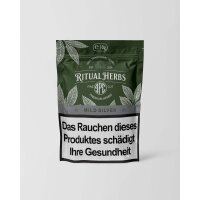
- Mild and Mild Silver come pre-cut and balanced. We do not recommend cutting them again.10
- This article is not a guide to preparing herbs for smoking. Smoke is still smoke, even without tobacco and nicotine.
Table of contents
- Loading...
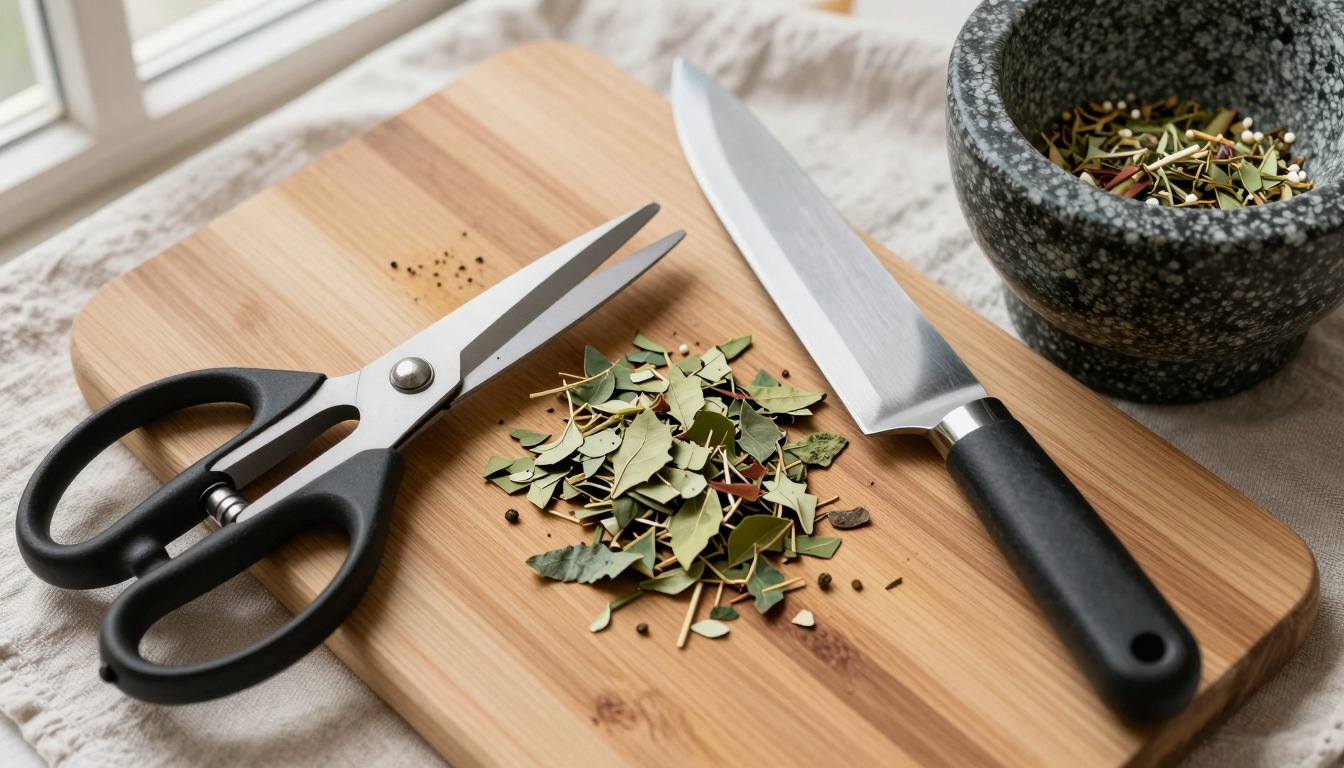
Cutting and grinding herbs is handwork, and the tool decides the cut. A knife cuts, a pestle rubs, a herb grinder breaks the leaf between blades. Here you will find when dried herbs are ready to be broken down, what five common tools do and where heat comes into play when grinding.
What the cut terms mean and what fine cut means in law is explained in Fine cut, coarse cut, stems: why the cut matters. Short definitions are in the glossary. This article is only about tools and techniques. “According to the manufacturer” means the Ritual Herbs product pages; where we draw our own conclusions, we say so.
Cutting and grinding herbs: when and why?
Anyone who works with dried leaves and flowers, for tea or spice blends in the kitchen, will break them down sooner or later. How small depends on the purpose. We found no standard for home use; the cut widths that do exist come from the tobacco sector, where they are trade custom.
One tip from a consumer guide concerns the order: do not cut herbs before drying, because cut surfaces expose more material to the air. After drying you may break them down, and it is better still to crumble them just before use.6 That is a rule of thumb from a single consumer site, not a study.
How dry do herbs need to be before cutting or grinding?
In short: when are dried herbs ready to be broken down?
A consumer guide names these signs that herbs are fully dried: they rustle to the touch and crumble easily. If they are stored too early, residual moisture can lead to mould.6
For drying in the oven, Öko-Test gives 40 or 50 degrees, with a wooden spoon wedged in the door so moisture can escape; after one to three hours the herbs are dry, and large-leaved ones such as sage need longer.7 Our conclusion, not a quote: a leaf that still bends instead of breaking is more likely to be squashed than cut. How to keep dried material dry afterwards is covered in How to store herbal blends.
Stripping (rebeln): starting by hand
Rebeln means stripping berries, small flowers or leaves from thin stems, mostly by hand. The DWDS gives rosemary, thyme and oregano as examples, as well as elderberries, currants and grapes. The word belongs to reiben (to rub), arose in wine-growing regions, is attested since the 18th century and is mainly usual in Austria.5
The technique from kitchen practice, not from the sources: you hold the sprig at the top and run two fingers down it until leaf and stem separate. The stem stays in your hand, the leaves fall into the bowl. Stripping is not cutting in the narrow sense, but it separates what should not end up in the cut material later.
Scissors and mincing knife: cutting
Herb scissors
Herb scissors are a special form of the pivot scissors with several pairs of blades.3 Our conclusion from the design: each cut produces several strips at once. The source does not describe this in more detail.
Mincing knife (Wiegemesser)
The mincing knife (German: Wiegemesser) has a curved blade of about 15 to 20 centimetres, sometimes two connected in parallel, and an upright handle at each end. You hold it with both hands and rock it back and forth over a cutting board. It is mainly used for chopping herbs. In the household it has largely been displaced by machines such as the hand blender and the food processor.2
Both tools cut, they do not rub. The leaf is divided into pieces, nothing more. How wide those pieces become is decided by the number of cuts; we cannot give you a target width in millimetres from any source.
Mortar and herb grinder: rubbing and breaking
Mortar
In short: what is a mortar?
A mortar is a grinding bowl with a pestle, and a thick vessel wall with a smooth inside. As materials the source names porcelain, agate, marble, granite, glass, bronze, iron and hard wood, among others.1
Grinding bowls (Reibschalen) have a rough surface on bowl and pestle and mostly consist of porcelain. With careful work and suitable powders, particle sizes down to 50 micrometres are possible, that is 0.05 millimetres. They are not suitable for greasy or oily preparations, though. According to the source, herbs can be broken down in a way that is “gentle on the aroma”, and with spices the flavour becomes more intense.1 How this was measured is not stated there.
Crushing food in a mortar is documented since the beginning of human history. A limestone mortar with pestle from Navalı Çori is dated to 8500 to 7900 BCE.1 A grinding bowl therefore produces powder rather than a cut. If you want a particular cut, you are better served by a knife or a grinder. That is our assessment.
Herb grinder
A herb grinder, also called a grinder, crusher or “Brösler” in German, consists in its basic form of two nested halves with blades or spikes inside. The herb lies between them, the halves are turned in opposite directions, and the blades break it down.4 Multi-part variants come with three to five parts: three-part ones have a collecting compartment, four-part ones add a sieve, five-part ones a finer second sieve or a storage compartment.4
As material the source mostly names acrylic, zinc, soapstone or wood, and for higher-quality models aluminium, stainless steel or titanium; some aluminium grinders are ceramic-coated.4 A sieve separates what is fine enough from the rest. That, too, is our conclusion from the construction.
Do herbs lose aroma when cut or ground?
In short: does aroma escape during grinding?
In industrial grinding of spices, yes: a review article in Foods (2026) writes that strong frictional heat during grinding at room temperature lets aroma compounds escape easily. For a mortar, scissors or herb grinder in the household we found no measurement.8
The introduction of a study on ginger and nutmeg gives 43 to 95 degrees in general as the temperature to which conventional mechanical grinding can heat spices; it bases this on another paper.9
All of this concerns machines with fast-running grinding units and spices, not leaves in a hand-turned herb grinder. Our conclusion: where less friction occurs and work is shorter, less heat is produced too. For hand tools this is not documented.
The tools at a glance
The table summarises what the sources say about each tool. Where a column would stay empty, there is no entry because we found no information.
| Tool | Principle | What the source says | Source |
|---|---|---|---|
| Hand (rebeln) | Stripping from thin stems | Rosemary, thyme, oregano; mainly used in Austria | 5 |
| Herb scissors | Pivot scissors with several pairs of blades | Special form of the pivot scissors | 3 |
| Mincing knife | Curved blade, two handles, rocking motion on the board | Blade about 15 to 20 cm; largely displaced by machines in the household | 2 |
| Mortar / grinding bowl | Pestle rubs in the bowl | Particle sizes down to 50 µm with careful work; herbs “gentle on the aroma” | 1 |
| Herb grinder | Two halves with blades or spikes, turned in opposite directions | Two halves as basic form, three to five parts; sieve in four- and five-part models | 4 |
Can you re-cut Mild and Mild Silver yourself?
In short: should you re-cut Mild or Mild Silver?
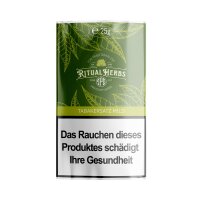
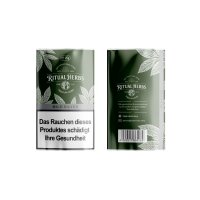
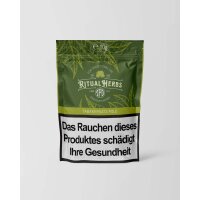
No, we do not recommend it. According to the manufacturer, cutting, blending and balancing the recipe are done in Germany, using methods aimed at a consistent structure and a calm burning behaviour. Mild and Mild Silver each have their own cut, matched to their profile.10
Anyone who changes the finished blend changes exactly what was balanced. Both varieties consist of the same seven plant ingredients: mullein leaves, blackberry leaves, lotus flower petals, hollyhock leaves, turmeric leaves, licorice root and licorice leaves.10
Everything in this article applies to cutting and grinding herbs in general, including plants that are not in Mild and Mild Silver. It is not a recommendation to smoke such plants. We found no study on the smoke of herbs you have cut yourself. What can be documented about the plants is covered in Which herbs can you smoke?. The basic handling of finished blends is described in How to roll tobacco substitute.
Mild and Mild Silver: the blends in the shop
Frequently asked questions
With your hands, scissors, a mincing knife or a mortar. Stripping (rebeln) separates leaves from thin stems, scissors and mincing knife cut, the mortar rubs. The herbs should be dry beforehand, meaning they rustle and crumble easily. We cannot give you a fixed target size from any source.2, 3, 1, 5, 6
In industrial grinding of spices, frictional heat can let aroma compounds escape, writes a review article from 2026. Whether this also applies to hand tools such as a mortar, scissors or herb grinder is open: for hand tools in the kitchen we found no measurement.8
We do not recommend it. According to the manufacturer, cut and blend are matched to the respective profile, and every pouch goes through the same inspection regardless of pack size.10 Both varieties come in 10 g and 25 g. This is an editorial position based on the manufacturer's information, not a ban.
We give no recommendation on this. Smoke from plant material contains combustion products, even without tobacco and nicotine, and we found no studies on herbs you have cut yourself, and smoke is still smoke. Which plants come into question at all is covered in Which herbs can you smoke?11, 12
An honest assessment
Tobacco-free does not mean risk-free. Smoke from plant material contains combustion products. A review in ACS Omega (2022) names carbon monoxide, polyaromatic compounds, nicotine and N-nitrosamines among the hazardous substances in herbal cigarettes.11 Carbon monoxide forms during incomplete combustion of carbon-containing substances and binds more strongly to the red blood pigment than oxygen does.13
A Korean study (2015) found no detectable nicotine in the smoke of a nicotine-free herbal cigarette, but more carbon monoxide and benzo[a]pyrene than in the smoke of a comparison cigarette. That concerns a single product, but shows that “nicotine-free” is no free pass.12
What we do not know: the figures on heat come from industrial spice mills, not from hand tools. The tool descriptions rest on reference works, not on tests.
With Mild and Mild Silver, tobacco and nicotine are left out. We claim nothing more. They are not a health product and not a means of quitting smoking. If you want to stop, you will find free counselling at rauchfrei-info.de, the information portal of the Federal Institute for Public Health (“Wir helfen kostenfrei”, that is, “We help free of charge”), also by phone on 0800 8 31 31 31 (Germany).14 Ritual Herbs is aimed at adults.
You can find Mild and Mild Silver, in 10 g and 25 g, under tobacco substitute.
Further reading
Sources
- Wikipedia (de): Mörser (Werkzeug). Retrieved October 2026. Construction, materials, grinding bowl, particle size down to 50 µm, herbs, history.
- Wikipedia (de): Wiegemesser. Retrieved October 2026. Construction, use, displacement in the household.
- Wikipedia (de): Schere. Retrieved October 2026. Section on herb scissors as a special form of the pivot scissors.
- Wikipedia (de): Kräutermühle. Retrieved October 2026. Construction, parts, materials, function.
- Digitales Wörterbuch der deutschen Sprache (DWDS): rebeln. Retrieved October 2026. Meaning, examples, origin, regional distribution.
- Alms I: Fünf Fehler, die Sie beim Trocknen von Kräutern nicht machen sollten. leinetal24.de, updated 30 Oct 2023. leinetal24.de. Retrieved October 2026. Consumer guide, not a study: signs of dryness, mould, timing of cutting or grinding.
- Wirag L: Kräuter trocknen: So machen Sie Kerbel, Koriander & Co. lange haltbar. ÖKO-TEST, 18 Jun 2024. oekotest.de. Retrieved October 2026. Oven at 40 to 50 degrees, air drying.
- Yang J, Ren Y, Xie B, Wan C, Xin S, Song K: Superfine Grinding for Edible Powders: Mechanisms, Quality Regulation, Limitations, and Synergistic Strategies. Foods 15(12):2050, 2026. PMC13297836. Retrieved October 2026 (review; frictional heat, aroma loss). Only the first half of the text was read; the cited passages are within it.
- Poliński S, Topka P, Tańska M, Kowalska S, Czaplicki S, Szydłowska-Czerniak A: Effect of Grinding Process Parameters and Storage Time on Extraction of Antioxidants from Ginger and Nutmeg. Molecules 27(21):7395, 2022. PMC9654629. Retrieved October 2026. Only the introduction on grinding heat (43 to 95 degrees, there with reference to another paper).
- Ritual Herbs: product pages Mild and Mild Silver (10 g, 25 g), as of October 2026. Cut, balancing, processing in Germany, ingredients. ritual-herbs.de/en/Tobacco-substitute
- Abdel Rahman RT, Kamal N, Mediani A, Farag MA: How Do Herbal Cigarettes Compare To Tobacco? ACS Omega 7(50):45797–45809, 2022. PMC9773184. Retrieved October 2026.
- Bak JH, Lee SM, Lim HB: Safety assessment of mainstream smoke of herbal cigarette. Toxicological Research 31(1):41–48, 2015. doi:10.5487/tr.2015.31.1.041 (abstract opened via Europe PMC).
- Wikipedia (de): Kohlenstoffmonoxid. Retrieved October 2026.
- Bundesinstitut für Öffentliche Gesundheit: rauchfrei-info.de. Retrieved October 2026.
x
Please sign in to write a comment.