
The key points
- The word history is secure: Rauch (smoke) is Old High German rouh (9th century), and "smoking tobacco" (Tabak rauchen) appears in German in the 17th century.7
- Jemandem blauen Dunst vormachen (literally "to make blue haze for someone") means to deceive. Where it comes from is disputed: the Duden names the smoke of magicians, the DWDS gives no origin, and blue long stood for lies.1, 2, 5
- Only Schall und Rauch ("sound and smoke") has a named source: Goethe's Faust.7, 8
- For starker Tobak ("strong tobacco") and anno Tobak the origin is unresolved.10, 13
- The Grimm dictionary already knows blawen dunst as deception. We could not open Röhrich's dictionary of proverbial sayings.25
Contents
- Loading...
German idioms about smoking often talk about smoke and mean something quite different. If someone "makes blue haze for you" (blauen Dunst vormachen) or "goes up in smoke" (in Rauch aufgehen), there is usually no cigarette in sight. This article follows the language history: what the dictionaries document, what is only told, and what remains disputed. The origin of Knaster is covered in the article Knaster: where the word for smoking tobacco comes from. The idioms are quoted in German; the English renderings are ours and literal, not established English sayings.
Which German idioms about smoking are there?
Quick answer: Which German idioms about smoking are well known?
Among the best known are jemandem blauen Dunst vormachen (to deceive someone), in Rauch aufgehen (to burn up, to come to nothing), Schall und Rauch (means nothing), wo Rauch ist, da ist auch Feuer (where there is smoke, there is fire) and starker Tobak (a bit much, hard to believe). The meanings are secure; only Schall und Rauch has a documented source, namely Goethe's Faust.1, 7, 10
What is documented and what stays open:
| Idiom (German) | Meaning | Origin | Source |
|---|---|---|---|
| jemandem blauen Dunst vormachen | to deceive someone | disputed (see below) | 1, 2, 5 |
| in Rauch (und Flammen) aufgehen | to burn up completely; to come to nothing | literal image | 7 |
| Schall und Rauch | means nothing | quotation from Goethe's Faust | 7, 8 |
| wo Rauch ist, da ist auch Feuer | everything has a cause | literal image | 7 |
| Friedenspfeife rauchen | to make peace, often jokingly | after the historical object | 14 |
| starker Tobak | a bit much, hard to believe | unresolved; documented since the 18th century | 10 |
| anno Tobak | jokingly: a long time ago | unresolved; interpretations: wordplay or anno domini | 10, 13 |
| nach jemandes Pfeife tanzen | to do as someone wants | pipe as a musical instrument | 11 |
Blue haze: magic trick, colour of lies or cigarette smoke?
Literally, Dunst is a clouding of the air. The DWDS (the German digital dictionary) documents this with a sentence by L. Frank: "Über den dämmerigen Wiesen schwebte blauer Dunst" (blue haze hung over the twilit meadows). The word is attested in Old High German; thunst meant "wind, storm" in the 10th century, and the root means "to scatter, to whirl", especially of dust, smoke and vapour.1
In a figurative and colloquial sense, jemandem blauen Dunst vormachen means, according to the DWDS, to try to make someone believe something untrue. The dictionary on wissen.de also lists in (blauen) Dunst auflösen (to dissolve into blue haze) in the sense of disappearing or coming to nothing.1, 4
That blauer Dunst can also mean cigarette smoke is shown by newspaper language. In 2007 the Rheinische Post called the agreement "to banish the blue haze largely from public life and even from pubs" sensible (our translation).6 DWDS and wissen.de do not list this sense as a meaning of its own.
The Deutsches Wörterbuch of the Brothers Grimm (volume 2) explains blauer dunst as "false appearance, deceitful pretence" and einem einen blauen dunst vormachen as "to deceive, to cheat someone by false pretence" (our translation). This is documented as early as older spellings (ihm einen blawen dunst für die augen machen, Mathesius; likewise Hans Sachs) and up to Schiller. In the parts of the text we could retrieve, neither a magician nor tobacco smoke appears.25
Disputed: Where does "jemandem blauen Dunst vormachen" come from?
Interpretation 1, magicians: The Duden explains the idiom "after the blue smoke that magicians used to let rise before performing their tricks" (our translation).2
Interpretation 2, the colour of deception: For a related idiom, das Blaue vom Himmel herunterlügen (to lie the blue down from the sky, that is, to tell tall tales), the Duden calls blue the "colour of deception, pretence and lies".3 An article on wissen.de says that until the late Middle Ages blue stood for pretence, lies and deception, and that this meaning lives on in blauen Dunst vormachen.5
What is missing: The DWDS gives no information on the origin of the idiom.1 Grimm documents the image of deception early, but in the parts we retrieved names no magician's smoke.25 Neither explanation is proven.
In Rauch aufgehen, Schall und Rauch
Under the headword Rauch the DWDS records fixed phrases: die Hütte ging in Rauch (und Flammen) auf means the hut burnt down completely; seine Hoffnung ging in Rauch auf, his hope came to nothing. Sein Geld, seine Pläne in den Rauch schreiben means to give them up for lost, and wo Rauch ist, da ist auch Feuer: everything has a cause.7 The DWDS offers no derivation; the image speaks for itself.
For Schall und Rauch, by contrast, the DWDS names a source, a quotation from Goethe's Faust, in the sense of "means nothing".7 Faust says the line in the scene "Marthens Garten" to Margarete, when she asks him whether he believes in God. He refuses to put a name to it: "Gefühl ist alles; Name ist Schall und Rauch, umnebelnd Himmelsglut" (feeling is everything; name is sound and smoke, clouding the glow of heaven; our translation). The DWDS gives the passage as line 3457.7, 8
“Name ist Schall und Rauch”
The Rauchzeichen (smoke signal) is also meant literally: a "sign given by smoke". Newspapers use it figuratively.9
Since when has German said "Tabak rauchen"?
Quick answer: Since when does "Tabak rauchen" exist in German?
According to the DWDS, the verb (Tabak) rauchen appears in the second half of the 17th century, probably after the French fumer du tabac. The word Rauch is much older: Old High German rouh, 9th century. Raucher (smoker) is documented since the 17th century, Nichtraucher (non-smoker) since the 19th.7
The word Tabak goes back to Spanish tabaco, a term from the language of the island Arawaks for a kind of cigarillo. In German travel accounts Tabacco appears in the second half of the 16th century, the Germanized form Tabak in the first half of the 17th.10 An influence of Arabic ṭubbāq on variant forms is considered possible, but not secure.10
Nach jemandes Pfeife tanzen (to dance to someone's pipe) means the pipe as a musical instrument: you dance to the tune the other person plays. The DWDS dates an early instance (wol tanzen nach mannes pfeifen) to the 15th century and considers it probably ambiguous. The tobacco pipe only came later, in the 17th century, after Dutch pijp; the word itself is Old High German phīfa (around 800).11
Qualmen, paffen, Glimmstängel: words around smoking
How someone smokes
Some verbs describe how someone smokes. According to the DWDS, schmauchen means, colloquially and jokingly, to smoke contentedly; it is documented since the 17th century and derived from Schmauch ("smoke, fumes"), related to English smoke.20 Qualmen means, in slang, to smoke heavily and often; Low German Qualm has been in High German since the 16th century, the verb since the 17th century also for excessive tobacco smoking.18 Paffen is meant disparagingly: to smoke quickly and in short puffs without inhaling. It comes from 18th-century student slang and imitates the sound at the pipe.19
Raucht wie ein Schlot (smokes like a chimney) means, according to the DWDS, that someone smokes very heavily. A Schlot is a tall chimney. Where the word comes from is unresolved; Middle High German slāt meant "smoke vent, chimney, stove opening".21
Where do "starker Tobak" and "anno Tobak" come from?
According to the DWDS, Tobak is the obsolete form of Tabak, which survives in dialects and jokingly in colloquial speech. Starker Tobak (also starker Tabak) means "a bit much, hard to believe" and has been documented since the 18th century.10, 12 How the image arose, the DWDS does not say. The thought of strong tobacco suggests itself, but is not documented in the dictionaries we opened.
Anno Tobak is a joking phrase for "back then", a long-gone time. The Etymologisches Wörterbuch lists it under Tabak as a playful formation on Tobak.10 The DWDS also quotes the Süddeutsche Zeitung (2013): the phrase refers to the time when tobacco became popular, and experts also explained it "as a deformation of anno domini", that is, "in the year of the Lord" (our translation).13 These are interpretations, not proof.
What does "Friedenspfeife rauchen" mean?
The DWDS distinguishes two meanings. Historically, the Friedenspfeife (peace pipe) is a smoking implement in some non-European cultures whose shared use sealed a peace (reference: Brockhaus 1906). Colloquially and often jokingly it stands for a gesture of goodwill in a quarrel.14
The DWDS lists Friedenspfeife rauchen only as a multi-word expression, without a definition of its own; the examples are figurative, for instance wurde die Friedenspfeife ausgepackt (the peace pipe was brought out; 2022).14 Related is the technical term Kalumet (calumet), in Karl May (Winnetou IV, 1910) a smoking implement with a fixed procedure, for example "six puffs" (sechs Züge).15 How the idiom entered German, the DWDS does not document. What the pipe meant in those cultures is told in Peace pipe and calumet.
Nicknames for the cigarette
According to the DWDS, Glimmstängel (literally "glow stick") arose around 1820 as a purist replacement word for Zigarre (to glimmen: to glow weakly, to burn without flame) and was later transferred to cigarettes; since the second half of the 19th century it only sounds jocular.16
Sargnagel (coffin nail) is a slang, jocular word for the cigarette. The DWDS documents this with a passage in Hans Fallada, where the cigarettes are called Sargnägel, "from which you only get brown fingernails" (our translation). The entry gives no derivation. Other names for the cigarette, according to the DWDS, are Fluppe, Kippe, Lulle, Lunte, Tschick (Austrian) and Zippe.17
What we do not know
Limits of this article
We opened the DWDS, the Duden and the dictionary on wissen.de. Grimm's dictionary (entry dunst) could only be read in text excerpts through the interface of the Wörterbuchnetz, and Röhrich's Lexikon der sprichwörtlichen Redensarten not at all. If you want to establish an origin with certainty, look there. For the magician interpretation we know of no contemporary evidence. The newspaper instance from 2007 only shows that blauer Dunst today also means tobacco smoke, not since when.
Mild and Mild Silver: without blue haze
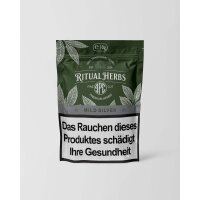
At Ritual Herbs the opposite of blue haze applies: Mild and Mild Silver contain the same seven plant ingredients, openly declared on the pack: mullein leaves, blackberry leaves, lotus flower petals, hollyhock leaves, turmeric leaves, licorice root and licorice leaves. Both varieties are tobacco-free and nicotine-free. You can find the range under Tobacco substitute.
Smoke is still smoke. Tobacco-free does not mean risk-free. A review in ACS Omega (2022) concludes that herbal cigarettes are "at least as dangerous as normal cigarettes"; convincing evidence of a positive effect on health was lacking.22 A Korean study (2015) found more carbon monoxide and benzo[a]pyrene in the smoke of an herbal cigarette without detectable nicotine than in the comparison cigarette. This concerns a single product, but it shows that "nicotine-free" is not a free pass.23
With Mild and Mild Silver, tobacco and nicotine are left out. We claim nothing more: they are not a health product and not a means of quitting smoking. If you want to stop, you can find free counselling at rauchfrei-info.de (in German), the portal of the German Federal Institute for Public Health; the phone counselling number is there too, 0800 8 31 31 31 (German-language service).24 Ritual Herbs is aimed at adults.
Mild and Mild Silver: the blends in the shop
Read more

Frequently asked questions
Literally it means to burn up completely, according to the DWDS: die Hütte ging in Rauch (und Flammen) auf. Figuratively it means that something comes to nothing, such as a hope or one's plans. The DWDS gives no derivation for this idiom.7
According to the DWDS, the verb (Tabak) rauchen appears in the second half of the 17th century, probably after the French fumer du tabac. Raucher is documented since the 17th century, Nichtraucher since the 19th. The noun Rauch is much older, with Old High German rouh.7
Sources
- DWDS (Digitales Wörterbuch der deutschen Sprache): Dunst (in German). Retrieved in October 2026. Meanings, blauer Dunst, etymology after Pfeifer.
- Duden: Dunst (in German). Retrieved in October 2026. Idiom and note on its origin (magicians).
- Duden: blau (in German). Retrieved in October 2026. "Blue as the colour of deception, pretence and lies".
- wissen.de, spelling dictionary: Dunst (in German). Retrieved in October 2026. Idioms with Dunst; the page does not say which work stands behind it.
- wissen.de: Keinen blauen Dunst: Was Blaumachen bedeutet (in German). Retrieved in October 2026. Secondary source on the colour blue; we did not adopt its statements on Bruegel and the Judenbuche.
- Rheinische Post, via presseportal.de: Rheinische Post: Blauer Dunst muss weichen (in German), 23 Feb 2007. Retrieved in October 2026.
- DWDS: Rauch (in German). Retrieved in October 2026. Idioms, Goethe quotation, etymology after Pfeifer, rauchen, Raucher, Nichtraucher, räuchern.
- Johann Wolfgang von Goethe: Faust. Eine Tragödie, scene "Marthens Garten", digitised after Reclam 1971: Projekt Gutenberg (in German). Retrieved in October 2026. The page gives no line numbers; line 3457 after the DWDS entry on Rauch (source 7).
- DWDS: Rauchzeichen (in German). Retrieved in October 2026.
- DWDS: Tabak (in German). Retrieved in October 2026. Etymology after Pfeifer, datings, starker Tobak.
- DWDS: Pfeife (in German). Retrieved in October 2026. Etymology, tobacco pipe, nach jemandes Pfeife tanzen.
- DWDS: Tobak (in German). Retrieved in October 2026.
- DWDS: anno Tobak (in German). Retrieved in October 2026. With a quoted instance from the Süddeutsche Zeitung (2013).
- DWDS: Friedenspfeife (in German). Retrieved in October 2026. Meanings, Brockhaus 1906, examples for Friedenspfeife rauchen.
- DWDS: Kalumet (in German). Retrieved in October 2026. Examples from Karl May, Winnetou IV (1910).
- DWDS: Glimmstängel (in German). Retrieved in October 2026.
- DWDS: Sargnagel (in German). Retrieved in October 2026. Fallada example, synonyms.
- DWDS: qualmen (in German). Retrieved in October 2026.
- DWDS: paffen (in German). Retrieved in October 2026.
- DWDS: schmauchen (in German). Retrieved in October 2026.
- DWDS: Schlot (in German). Retrieved in October 2026.
- Abdel Rahman RT, Kamal N, Mediani A, Farag MA: How Do Herbal Cigarettes Compare To Tobacco? ACS Omega 7(50):45797–45809, 2022. PMC9773184.
- Bak JH, Lee SM, Lim HB: Safety assessment of mainstream smoke of herbal cigarette. Toxicological Research 31(1):41–48, 2015. doi:10.5487/tr.2015.31.1.041. Abstract only.
- Bundesinstitut für Öffentliche Gesundheit: rauchfrei-info.de (in German). Retrieved in October 2026.
- Brothers Grimm: Deutsches Wörterbuch, volume 2, entry dunst (Trier Wörterbuchnetz, ID D05763): woerterbuchnetz.de (in German). Retrieved in October 2026 through the open interface of the Wörterbuchnetz (full-text hits of the entry, in text excerpts); the page itself is only readable with JavaScript.
x
Please sign in to write a comment.