
The short version
- After every smoke: let the pipe cool, empty out the remains, draw a pipe cleaner through the draught channel until it comes out clean, then let the pipe rest.1, 2, 3
- On a wooden pipe the layer of carbon in the bowl (cake) is not removed but kept thin. As a rule of thumb it is about the thickness of a coin, roughly 1.5 to 2 mm.5, 13
- For a deep clean the sources name alcohol, and for stubborn odours a salt treatment. The salt treatment is controversial among pipe smokers.1, 7
- All the guides describe pipe tobacco. We have not found any evidence that herbal remains behave the same way. Smoke stays smoke: even without tobacco and nicotine, combustion products are produced.9, 10
Table of contents
- Loading...
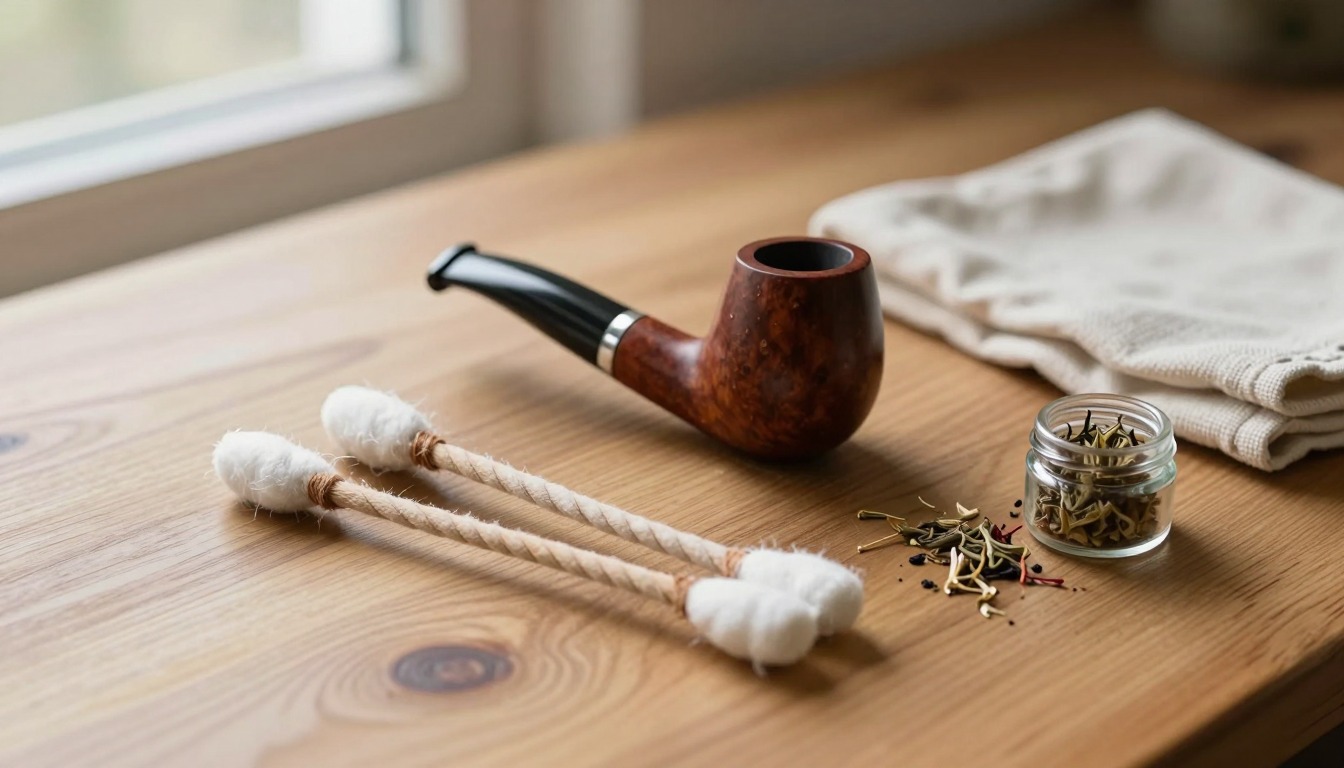
Cleaning a pipe mainly means clearing the draught channel after every use and giving the pipe time to dry. Here you will find the routine that pipe retailers and guides describe, plus deep cleaning, the carbon layer and mouthpiece care. How a pipe is built is explained in Pipe structure: parts, briar wood and craft, and how it is packed in How to pack a pipe with herbs. This article covers what comes afterwards.
How do you clean the pipe after smoking?
Short answer: How do you clean a pipe after smoking?
You let the pipe cool, empty out the ash and remains and draw a pipe cleaner through the draught channel until it comes out clean. Then you wipe the rim and let the pipe rest before smoking it again. A hot mouthpiece is never forced off the bowl.1, 2, 3
Schritt 1
Let it cool.
The mouthpiece is only removed once the pipe is cold. Bespoke Unit gives the reason that otherwise the wood of the shank can crack; an English-language pipe guide names the risk of the mouthpiece warping. [1, 3, 5]
Schritt 2
Empty it out.
Ash and remains come out. You can loosen loose bits of carbon gently with the blunt blade or the spoon of the pipe tool, without scraping the wall. [1, 2]
Schritt 3
Draw the cleaner through the channel.
A bristle cleaner is pulled through the mouthpiece until it is just visible at the bottom of the bowl, and this is repeated until it comes out clean. You are not supposed to be rough about it. [2, 3]
Schritt 4
Do not forget the mortise.
A German retailer advises cleaning it as well. Otherwise the mouthpiece can get stuck later and can no longer be removed. [4]
Schritt 5
Wipe the rim and mouthpiece.
Bespoke Unit rubs dark deposits on the rim off with a fingertip moistened with saliva or a wrapped finger; smokingpipes.eu wipes the mouthpiece with a moistened cleaner. [1, 2]
Schritt 6
Let it rest.
More on this in the next section.
If you use a filter, Tabak Brucker says to change it after every use.4 We make no statement about how filters work.
How long does a pipe need to rest?
When you smoke, heat and moisture get into the pipe. Rauch Lounge writes that it then needs enough time to cool and dry, and that anyone who smokes regularly should therefore alternate between several pipes.3 Smokingpipes.eu names a specific span: two to four days before the same pipe is smoked again.2 That is a retailer’s recommendation, not a measurement. If the pipe tastes harsh, Tabak Brucker says to let it go out completely and dry for a day.4
Cleaning a pipe: the deep clean
The routine clears the channel, but deposits in the shank and bowl remain. Bespoke Unit therefore divides care into daily, weekly (alcohol cleaning) and monthly (thorough version), but qualifies this itself: the monthly clean is not needed every month. Smokingpipes.eu recommends deep cleaning at your own discretion. That is the suggestion of individual guides; how often you do it depends on how often you smoke and how the pipe tastes.1
| Area | Method according to the source | Source |
|---|---|---|
| Stem | Draw a cleaner dipped in alcohol through it, then draw dry cleaners through until the wet one comes out as clean as the dry one | [2] |
| Airway in the bowl | Brush out with alcohol-moistened, then dry bristle cleaners | [2] |
| Mortise | Clean with cotton swabs or a shank brush | [2] |
| Inner wall of the bowl | Dip a folded cleaner in alcohol and rub the wall; a paper towel in the bowl catches overflowing alcohol | [1] |
| Rim with crusted deposits | Carefully scrape with a blunt blade; instead of rubbing alcohol, Bespoke Unit uses a spirit such as brandy or dark rum | [1] |
Afterwards the pipe needs time for the alcohol to evaporate completely. Smokingpipes.eu allows “a day or so”, Bespoke Unit at least 24 hours before the next use.1, 2 The sources disagree on which alcohol is the right one: smokingpipes.eu names “pipe sweetener” or “grain alcohol”, Bespoke Unit recommends spirits rather than strong cleaning alcohol, and Steve Laug on rebornpipes.com recommends isopropyl alcohol, preferably 99 %, if necessary 91 %.1, 2, 7 We do not make a recommendation. Alcohol should not run onto the outer finish.7
Salt and alcohol: what is controversial about it?
Short answer: What does a salt treatment do in a pipe?
In a salt treatment the pipe bowl is filled with coarse salt and soaked with alcohol. The aim is for a sour pipe to taste milder again and for flavour residues (“ghosting”) to disappear. The author of one guide has used it for over 15 years; other pipe smokers report cracked bowls.7
The two guides we opened are similar: the bowl is filled with salt, alcohol is added until the salt is moist, the pipe stands for about 24 hours, then the salt is removed and the bowl is wiped out.1, 7 Laug uses coarse kosher salt, explicitly not iodised; Bespoke Unit names kosher or sea salt and says table salt is hard to remove again. They part ways on drying: Bespoke Unit lets the bowl dry for another 24 hours after scraping, Laug for several days.1, 7
Laug himself names the opposing voices: split shanks, cracked bowls, ruined pipes. He considers this a myth. Since 2017 he has advised against salt in the shank; he now uses cotton balls there.7 We have not found an independent test of the method. If you are unsure, stick with the alcohol cleaning.
What is the carbon layer and how thick may it be?
Short answer: What is cake in a pipe?
Cake is the layer of charred residue on the bowl wall. It insulates the bowl from direct heat but can make it crack if it gets too thick. As a rule of thumb, pipe literature gives about the thickness of a US dime, roughly 1.5 to 2 mm; the figures vary.1, 5, 13
On a new wooden pipe the layer builds up gradually while it is being broken in. According to Bespoke Unit and smokingpipes.eu, it insulates the pipe against direct heat.1, 2 A French pipe boutique lets it grow over the first 10 to 15 smokes and fills the bowl first a third, then two thirds, then completely; an English-language guide names alternating half and full bowls.5, 13 Smokingpipes.eu adds that knocking the pipe out after smoking speeds up the build-up.2 You should not overheat the pipe in the process; Tabak Brucker warns in general against drawing too hard and too fast.4
If the layer gets too thick, the reamer comes into play. Bespoke Unit describes it like this: insert it, press lightly, a few turns clockwise, then a few the other way, knock out the remains and wipe over with an alcohol-moistened cleaner. Reaming is only done every few months or when the taste turns bitter or sour.1 According to an English-language guide, tar in the shank and airway is harder to remove; in the worst case you need a pipe restorer.5
Caring for the mouthpiece
Mouthpieces made of ebonite (hard rubber) turn greenish through oxidation and then taste unpleasant. According to a German-language reference work, they therefore often need to be cleaned and polished.6 For a greenish tinge, Bespoke Unit describes two ways: overnight in hot water with plenty of Oxi-Clean, covering markings with Vaseline beforehand, or, if that does not help, rubbing with bleach cream for about 30 minutes. Afterwards the mouthpiece is conditioned with Vaseline or olive oil.1 This is the account of a single source; if a mouthpiece is made of acrylic or has a special imprint, you should ask the retailer first.
Cleaning by material
| Material | What the sources say about care | Source |
|---|---|---|
| Briar (wood) | Break in to form a carbon layer; keep the cake thin; salt treatment controversial | [4], [5], [7] |
| Meerschaum | Breaking in unnecessary; cake unwanted; softens with heat, so let it cool before cleaning | [5], [6] |
| Clay | To be cleaned completely after use by firing it out; cake from other pipes can damage clay and meerschaum bowls | [5], [6] |
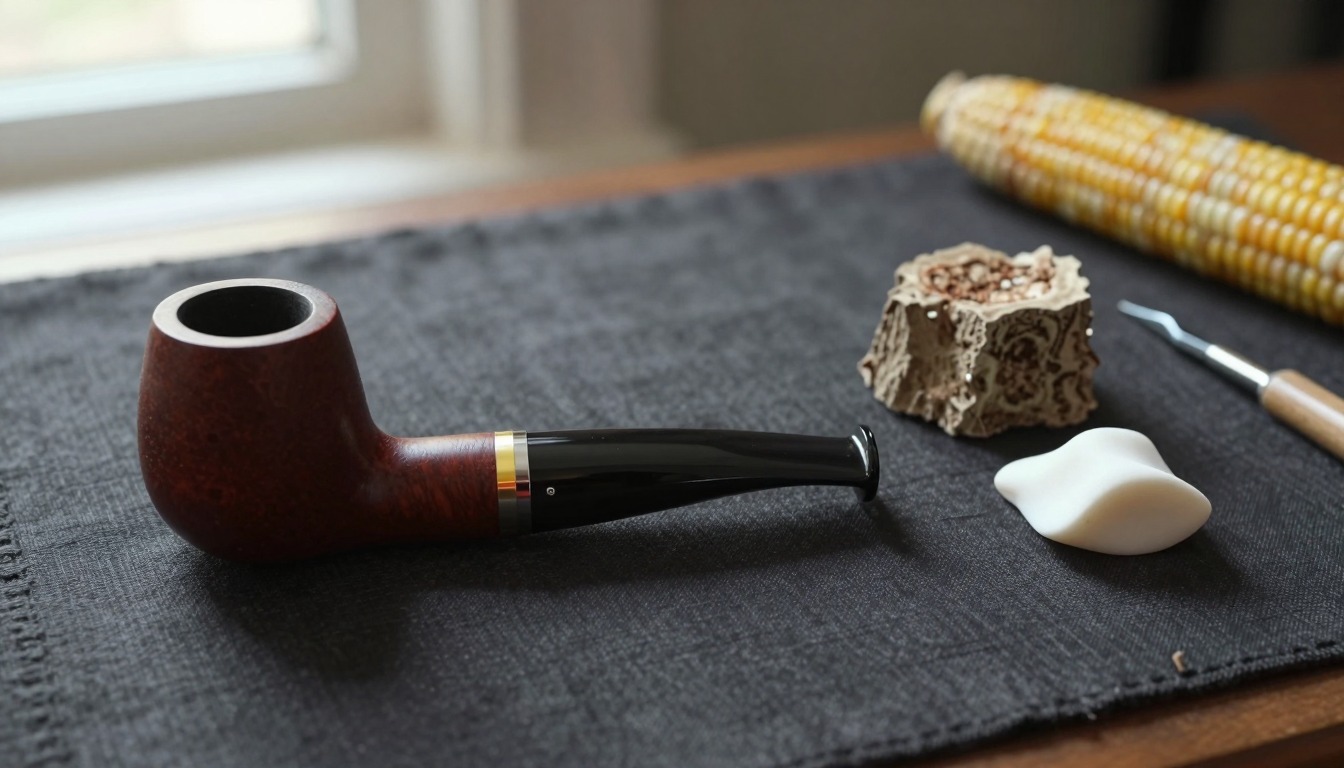
| Corncob | No breaking in needed as with briar | [5] |
More about the materials themselves can be found in Pipe structure: parts, briar wood and craft, and about their history in meerschaum pipes and clay pipes from Holland.
And what if herbs have been in the pipe?
All the guides mentioned are written for pipe tobacco. We have not found a source describing how to care for a pipe after herbal blends. Whether herbal remains behave differently in the channel and bowl than tobacco remains, we therefore do not know, and we do not claim it.
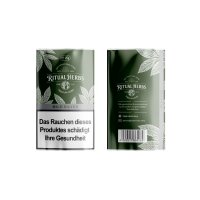
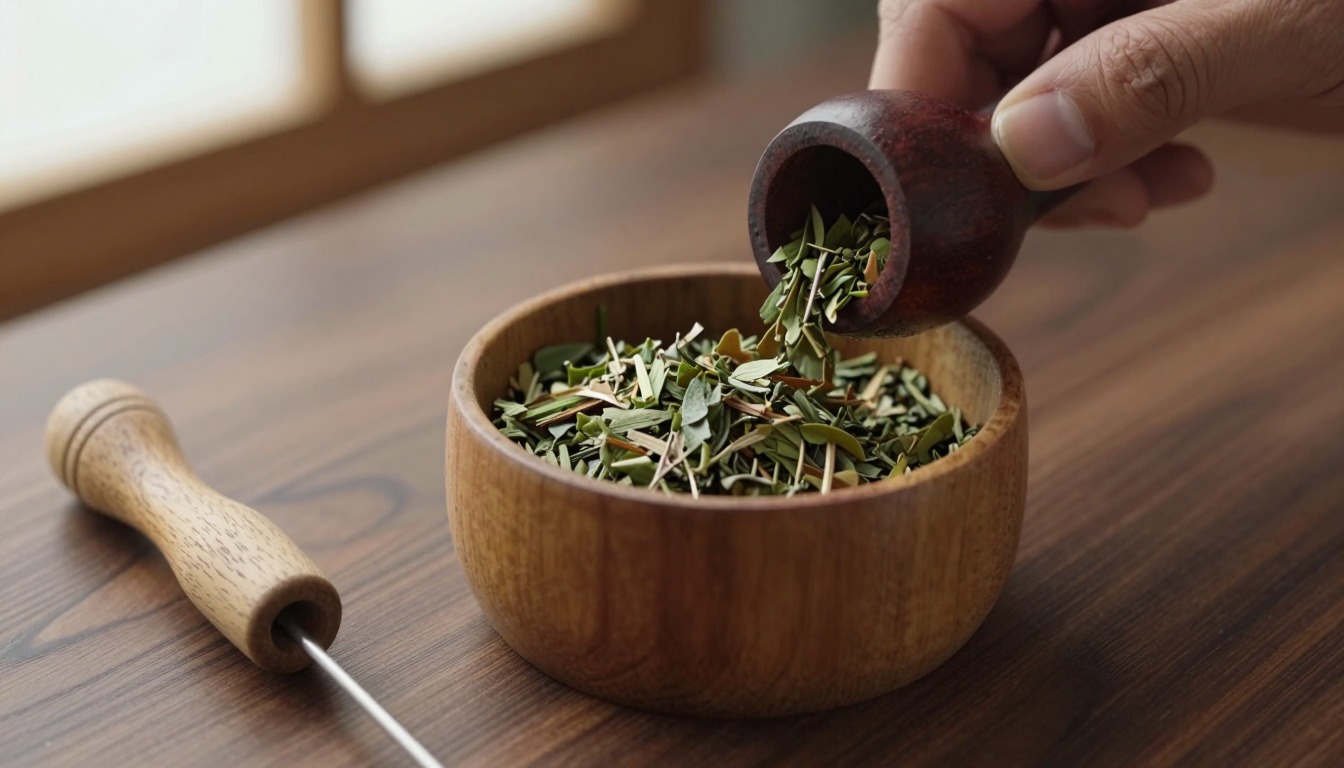
What is documented is the manufacturer’s statement: Mild and Mild Silver can be rolled, packed or used in a pipe like conventional fine-cut. Both are tobacco-free and nicotine-free and consist of the same seven plant ingredients (mullein leaves, blackberry leaves, lotus petals, marshmallow leaves, turmeric leaves, liquorice root, liquorice leaves).8 The sources do not tie cooling, cleaning and drying to any type of tobacco; we carry this over as a basic rule, but it is not documented for herbs. For the residual moisture of the blend and for the ember going out, there is more in Why do herbal cigarettes go out?; for rolling instead of packing, see How to roll tobacco substitute. You can find the range under Tobacco substitute.
Frequently asked questions
Smoke stays smoke: an honest assessment
Tobacco-free does not mean risk-free. A review in ACS Omega (2022) lists carbon monoxide, polyaromatic compounds and N-nitrosamines, among others, as toxins in the smoke of herbal cigarettes.9 Carbon monoxide forms during incomplete combustion of carbon-containing substances and binds to the red blood pigment more strongly than oxygen.11
A Korean study (2015) found a higher mutagenic potential in the condensate of one herbal cigarette than in the comparison cigarette at the same concentration; carbon monoxide and benzo[a]pyrene were higher, while nicotine and tobacco-specific nitrosamines (TSNA) were not detectable. This concerns a single product, but it shows that “nicotine-free” is no free pass.10 We have found no study on smoke from a pipe.
With Mild and Mild Silver, tobacco and nicotine are left out. We claim nothing more. They are not a health product and not a means of quitting smoking. If you want to stop, you can find support at rauchfrei-info.de, the information portal of the German Federal Institute for Public Health, and by phone on 0800 8 31 31 31 (Germany).12 Ritual Herbs is aimed at adults.
Mild and Mild Silver



Sources
The care instructions in sources 1 to 4, 7 and 13 come from retailers, guide websites and a pipe blog and are secondary sources. We have not found a museum or scientific source on pipe cleaning.
- Bespoke Unit: How To Clean A Pipe. Retrieved October 2026. Guide, secondary source. Routine, intervals, reamer, salt treatment, ebonite.
- Smokingpipes.eu (Laudisi Enterprises, Inc.): How To Clean A Pipe. Retrieved October 2026. Retailer, secondary source.
- Rauch Lounge, Heinsberg: Pfeife richtig rauchen. Retrieved October 2026. Retailer, secondary source. (German-language source.)
- Tabak Brucker, Rosenheim: Pfeife rauchen: so geht es richtig. Retrieved October 2026. Retailer, secondary source. (German-language source.)
- Wikipedia (en): Tobacco pipe. Retrieved October 2026 (sections Use, Cleaning, Bowl materials). Starting point; cake, meerschaum, corncob, cooling.
- Wikipedia (de): Tabakpfeife. Retrieved October 2026 (sections on structure and materials). Starting point. (German-language source.)
- Laug S: To Use or Not to Use – the Salt and Alcohol Treatment. rebornpipes.com, 8 February 2013. Retrieved October 2026. Account by a pipe restorer, secondary source.
- Ritual Herbs: product pages Mild and Mild Silver, 10 g and 25 g (manufacturer information), as of 5 October 2026: ritual-herbs.de/en/Tobacco-substitute.
- Abdel Rahman RT, Kamal N, Mediani A, Farag MA: How Do Herbal Cigarettes Compare To Tobacco? ACS Omega 7(50):45797–45809, 2022. PMC9773184.
- Bak JH, Lee SM, Lim HB: Safety assessment of mainstream smoke of herbal cigarette. Toxicological Research 31(1):41–48, 2015. doi:10.5487/tr.2015.31.1.041.
- Wikipedia (de): Kohlenstoffmonoxid. Retrieved October 2026. (German-language source.)
- Bundesinstitut für Öffentliche Gesundheit: rauchfrei-info.de. Retrieved October 2026. (German-language source.)
- La Pipe Rit, Saint-Claude (France): A well caked pipe. Retrieved October 2026. Retailer, secondary source. Cake thickness, breaking in.
Read more
x
Please sign in to write a comment.